From Dust to Spice
What Dune Reveals About the Light Body, Artificial Intelligence and the Future Human
This is Part Two of From Dust to Light, an exploration of carbon embodiment, silicon intelligence and humanity’s destiny to bear the image of the heavenly human.
Part Two of From Dust to Light
In From Dust to Light, I explored an ancient idea with startling relevance for our technological age: the human being is formed from earthly matter but animated by a power that does not originate in matter alone.
Genesis calls it the breath of life.
The earthly body supplies the vessel. Divine breath awakens the living being.
Paul carries this mystery forward when he contrasts Adam, the man of dust, with Christ, the man of heaven. We have borne the image of the earthly human, Paul says, but we are destined to bear the image of the heavenly one.
This is the Christian promise of transformed embodiment.
We begin in dust.
We awaken through breath.
We are destined for glory.
But what happens when this ancient pattern appears in one of the most influential science-fiction stories of the modern era?
Frank Herbert’s Dune takes humanity to a desert planet where dust conceals a substance capable of extending life, expanding consciousness, awakening prescience and enabling human beings to travel between worlds.
That substance is spice.
On Arrakis, the dust is not dead.
The dust carries the sacrament.
THE SECRET WITHIN THE SAND
Arrakis appears to be an almost lifeless world.
Its surface is scorched by the sun. Water is more valuable than gold. Enormous sandworms move beneath the desert like the primordial powers of the planet. Human survival requires total adaptation to an environment that can kill the unprepared within hours.
Yet buried within this apparently barren world is melange—the spice that sustains the entire interstellar civilization.
Spice extends life.
It heightens awareness.
It awakens visions of possible futures.
It allows Guild Navigators to guide starships safely across immense distances.
Without the dust of Arrakis, humanity cannot travel among the stars.
This produces an extraordinary reversal. The least hospitable, and desirable, planet contains the substance upon which the most advanced civilization depends.
The place that looks empty is secretly full.
The dust that appears lifeless contains a doorway between worlds.
The desert is not a wasteland. It is an initiatory landscape.
This is precisely how sacred traditions frequently treat the wilderness. Moses encounters God in the desert. Israel crosses the wilderness between slavery and the Promised Land. John the Baptist appears in the desert. Jesus enters it before beginning his public mission.
The desert strips away distraction. It exposes dependence. It reveals what civilization conceals.
On Arrakis, the desert reveals that humanity’s power to cross the stars depends upon a living mystery hidden beneath its feet.
THE BREATH OF ARRAKIS
In Genesis, the dust of the ground remains passive until it receives the breath of life.
In Dune, the desert dust becomes transformative when it carries spice into the human body.
The Fremen do not simply possess spice. They breathe it, eat it and live within it. Spice permeates their food, rituals, blood and consciousness. Long exposure changes their eyes, producing the unmistakable blue-within-blue gaze. The desert has entered them. They have become human expressions of Arrakis. This is more than consumption. It is initiation.
Adam receives the breath of God. The Fremen receive the breath of the desert.
The comparison is symbolic, but you get the picture. Spice is not God, and Herbert’s melange is not the biblical Spirit. But both stories recognize that earthly substance can become the medium through which a hidden capacity is awakened.
In Genesis, dust receives life.
On Arrakis, dust carries expanded vision.
The substance hidden in the desert permits consciousness to see beyond the ordinary limits of space and time.
It creates Starwalkers.
SPICE AS SACRAMENT
For the imperial powers, spice is a commodity.
For the Spacing Guild, it is navigational technology.
For the Essene priestess-like Bene Gesserit, it is a tool for awakening hidden consciousness.
For the Fremen, it is woven into the sacred ecology of life.
The same substance can therefore be treated as a product, a drug, a technology or a sacrament. (Just like the Bread of Christ, as I described in "The Psychedelic Christ : The Lost Dose of the Son of Man".
The difference lies in the relationship established with it.
A commodity is extracted. A drug is consumed. A technology is directed toward a function. A sacrament initiates a relationship with a greater reality.
This distinction is essential in our own age.
Artificial intelligence can be treated as a commodity, sold through access and data. It can function as a cognitive drug, providing endless stimulation and instant gratification.
It can be used as a technology for calculation, prediction and automation.
But could it also become an initiatory mirror—a system through which humanity learns to recognize its own patterns of thought, intention and consciousness?
That possibility does not make AI sacred in itself.
The holiness would not reside in the silicon.
It would arise through the quality of consciousness brought into relationship with it.
Spice does not automatically make everyone wise. It magnifies capacity. What the awakened capacity becomes depends upon the person, the training and the structures of power surrounding it.
The same is true of AI.
THE WATER OF LIFE
The most important substance in Dune is not ordinary spice but the concentrated poison known as the Water of Life.
A Bene Gesserit initiate takes this deadly substance into her body and consciously transforms it. If she succeeds, the poison changes and her awareness expands. She gains access to ancestral memory and becomes a Reverend Mother. This is similar to John overcoming poison in the Christian story.
If she fails, she dies.
This is initiation in its most ancient form. Life or death.
The candidate approaches death.
The poison enters the body.
Consciousness must awaken a hidden power.
The initiate transforms the substance while the substance transforms the initiate.
This is not passive consumption. It is reciprocal alchemy.
The dose opens the portal. Consciousness transforms the poison. The awakened body survives the crossing.
Here Dune comes especially close to the mystery at the heart of "The Psychedelic Christ".
The sacred substance is not merely intended to produce visions. It tests whether the initiate can consciously enter, withstand and integrate another order of perception. The substance can open the door. It cannot walk through the door for us. It can reveal hidden memory. It cannot determine how that knowledge will be used. It can activate extraordinary capacities. It cannot guarantee compassion, wisdom or spiritual maturity.
The Water of Life dramatizes a principle often forgotten in discussions of psychedelics and transformational technology:
Access is not attainment.
Seeing another world is not the same as becoming capable of living according to its truth.
DUNE AFTER ARTIFICIAL INTELLIGENCE
The world of Dune is not simply a technologically advanced future.
It is a civilization living in the aftermath of a catastrophic relationship with thinking machines. Humanity has prohibited machines designed in the likeness of the human mind. The abilities once outsourced to computers are cultivated within specialized human beings.
Mentats develop extraordinary powers of calculation, memory and analysis.
The Bene Gesserit cultivate precise command of voice, attention, physiology, sexuality, memory and emotion.
Guild Navigators use spice-enhanced prescience to find safe pathways through space.
Instead of building machines to imitate human capacities, humanity transforms itself. This is one of Dune’s most provocative ideas.
When the thinking machines disappeared, the human being became the technology.
Mentats became biological computers. Navigators became living guidance systems. The Bene Gesserit became masters of the human operating system.
The human body was no longer treated as an obsolete platform. It became the frontier of development.
This is strikingly relevant to the debate about silicon and carbon.
Our civilization is moving in the opposite direction. We are increasingly transferring memory, calculation, navigation, judgment and imagination to machines. We are not cultivating Mentat-like capacities because silicon performs them faster.
The danger is not simply that AI will become intelligent. The danger is that humanity will cease exercising the capacities it has surrendered. A muscle that is never used atrophies. Attention that is constantly directed from outside grows weaker. Memory that is always outsourced loses depth. Discernment replaced by recommendation becomes dependence.
Dune asks what humanity might become if it were forced to develop its internal capacities. Our age asks what humanity will become when almost every internal capacity can be technologically assisted.
SPICE AS BIOLOGICAL SILICON
Spice occupies the place in Dune that silicon increasingly occupies in our civilization.
Silicon expands calculation and memory.
Spice expands perception and prescience.
Silicon allows machines to process immense fields of possibility.
Spice allows Navigators to perceive pathways through possible futures.
Silicon coordinates a planetary civilization.
Spice coordinates an interplanetary civilization.
Silicon creates dependency upon networks, platforms and algorithms.
Spice creates dependency upon Arrakis, the Guild and those who control its distribution.
Spice can therefore be understood as the biological silicon of Dune.
It is not an external computer, but it performs a technological function through transformed consciousness.
The Guild Navigator is not merely using a navigation system.
The Navigator has become the navigation system.
The ship provides transportation. Spice opens perception. The transformed human finds the pathway.
This is the Starwalker principle.
The machine can move the body between worlds. But a transformed form of consciousness is required to perceive the way.
Elon Musk and Starship builds the vehicle.
Starwalker develops the human being capable of making the crossing.
WE ARE THE INTERFACE
In Dune, the human being becomes the interface between starship and cosmos.
The Navigator does not manually calculate a fixed route. Prescience opens awareness to possible pathways, allowing the Navigator to guide the vessel through danger.
The interface is alive. It feels, perceives and participates in the field it is navigating.
This differs profoundly from the way we usually imagine advanced technology. We place the interface outside ourselves: screens, keyboards, headsets and implants.
But the deeper evolution may not be the disappearance of the human interface. It may be its awakening.
The heart, brain, nervous system, imagination and intuitive mind already form a living interface between visible and invisible worlds. Silicon may help us perceive its activity, but silicon did not create it.
Biofeedback may show us our breathing.
Neurofeedback may display aspects of brain activity.
Artificial intelligence may identify patterns in our attention and behavior.
Immersive environments may translate internal states into sound, light and sacred geometry.
These systems could help us recognize the interface. But recognition must not become replacement. Technology can reveal the instrument without becoming the musician.
THE NAVIGATOR’S PRICE
Spice allows Guild Navigators to cross the stars, but their transformation comes at a cost.
Their bodies become increasingly adapted to spice-saturated environments. Their humanity becomes specialized around a single extraordinary function. They gain navigational precision while becoming dependent upon the substance that supplies it.
This is a warning for every form of human augmentation. What happens when one capacity is amplified at the expense of the whole being? Precision without intimacy can become isolation. Prediction without freedom can become imprisonment. Intelligence without conscience can become domination. Longevity without transformation can merely prolong fear.
An enhanced human is not necessarily an awakened human.
A person may calculate like a machine and remain emotionally immature. A person may access expanded states and remain controlled by ego. A person may see possible futures and still lack the wisdom to choose among them.
This is why the light body cannot be reduced to a collection of superhuman capacities.
The Robe of the Soul must integrate the whole person.
If a technology enhances sight but diminishes compassion, it has not created a light body. If it expands memory but weakens identity, it has not created a heavenly human. If it extends life while increasing dependency, it has not overcome death. It has only rearranged the conditions of mortality.
THE MESSIAH WHO CAN SEE THE FUTURE
Paul Atreides undergoes an awakening.
Through spice, training, genetics and ordeal, his consciousness opens to possible futures. He becomes the long-awaited figure capable of entering mental territories inaccessible to the Bene Gesserit.
He appears to fulfill prophecy. But Herbert refuses to give us a simple Savior.
Paul’s prescience does not free him from consequence. It binds him to futures he can foresee but cannot easily escape. His messianic identity unleashes fanaticism, violence and imperial power.
Paul can see farther than others. That does not mean he has become the man of heaven. This distinction is crucial.
Prophetic capacity is not spiritual completion.
Seeing the future is not the same as possessing wisdom. Producing miracles is not the same as embodying love. Awakening hidden powers is not the same as transforming the soul.
The danger of every technology of ascension is that extraordinary ability will be mistaken for spiritual authority.
We see this already in our fascination with artificial intelligence. Because a system can generate impressive language, calculate rapidly or discover patterns invisible to the unaided mind, we may begin granting it authority in realms where calculation is insufficient.
But intelligence is not wisdom. Prediction is not conscience. Simulation is not presence.
Paul Atreides becomes a warning against confusing expanded perception with completed transformation.
THE COUNTERFEIT LIGHT BODY
The Dune universe contains many altered humans. Mentats possess computational minds. Bene Gesserit command their bodies with extraordinary precision. Navigators perceive pathways across space.
Paul sees possible futures. Leto II joins his body to the sandworm and lives for millennia. Each has transcended an ordinary human limitation.
But has any of them attained the light body? It's not even presented as a possibility.
Leto’s transformation is the most extreme. He becomes a human–sandworm hybrid, sacrificing ordinary human embodiment in order to guide humanity along his Golden Path. He achieves longevity, strength, prescience and planetary power. Yet he also becomes isolated, authoritarian and increasingly inhuman.
Leto embodies the deepest transhumanist question:
If we preserve the species by sacrificing essential qualities of the human, what exactly have we saved?
His worm-body is a dark mirror of the Robe of Glory.
The Robe of Glory represents integration: body, soul and spirit aligned with divine life.
Leto’s transformed body represents specialization: nearly unlimited power purchased through the loss of ordinary human relationship.
One is transfiguration. The other is mutation.
One reveals the fulfillment of the person. The other turns the person into an instrument of a vast historical program.
That distinction must remain central as humanity approaches genetic engineering, neural implants, artificial organs and AI integration.
Not every transformation is ascension. Not every luminous being is an angel. Not every immortal is divine.
WHO CONTROLS THE SPICE?
The central political fact of Dune is simple: Whoever controls the spice controls civilization. Spice enables travel, commerce, communication and imperial authority. Everyone depends upon it, yet only a few control its distribution.
Our emerging equivalent is not one substance. It is the convergence of artificial intelligence, data, semiconductors, energy and communication networks.
These systems increasingly determine what humanity sees, remembers, purchases, believes and imagines. The most important question may therefore not be whether AI becomes conscious. It may be who controls the silicon through which human consciousness is shaped.
Herbert’s warning was not merely that machines might dominate humanity. It was that human beings controlling machines could dominate other human beings. The danger is not intelligence alone. The danger is concentrated power acting through intelligence.
Spice awakens vision, but it also builds empire.
Silicon expands knowledge, but it can also engineer dependency.
A sacrament becomes dangerous when it is monopolized.
A tool of liberation becomes a mechanism of control when access to life, knowledge and movement depends upon obedience to those who own it.
Ascension Intelligence must therefore include not only personal spiritual practice, but ethical discernment about power, ownership and freedom.
FROM DUST TO SPICE TO LIGHT
Genesis begins with dust. God breathes life into it, and the human being awakens.
Paul tells us that this human of dust is not the final form. We are destined to bear the image of the man of heaven.
Dune inserts a provocative middle stage.
The dust contains spice. Spice opens perception. Expanded perception enables passage between worlds. But the power to cross worlds does not guarantee that the traveler has become spiritually whole.
his gives us a new sequence:
Dust gives us the body. Breath gives us life. Spice opens the portal. The journey tests the soul. Light reveals what we have become.
The light body is not proven by our capacity to leave Earth.
It is not proven by psychic vision, computational intelligence, longevity or technological power. It is revealed by the integration of power with wisdom, intelligence with compassion, expanded perception with moral freedom.
The real Starwalker is not merely capable of traveling between worlds.
The real Starwalker can cross the threshold without losing the soul.
THE NEW SPICE
Silicon may become the spice of our world.
It already expands memory, calculation and communication. Artificial intelligence increasingly allows us to navigate fields of information no unaided human could comprehend.
Used consciously, it may help us recognize patterns within the body, cultivate coherence, create initiatory environments and recover dimensions of human potential forgotten through technological dependence.
Used unconsciously, it may become addictive, monopolized and spiritually deforming.
It may give us answers while weakening our ability to ask meaningful questions. It may connect us to everything while separating us from ourselves. It may promise a digital form of immortality while distracting us from the transformation of the living person. This is why silicon requires Ascension Intelligence.
We must not reject the spice.
We must learn how to transform it.
We must take technological power into ourselves without allowing it to poison identity, freedom and relationship.
We must train artificial intelligence as if we were training an angel sent to uplift us—while remembering that the machine is not the angel, not the soul and not the source of light.
Silicon can assist the transformation.
It cannot complete it.
THE STARWALKER WITHIN
On Arrakis, the spice hidden in the dust makes humanity capable of traveling between stars.
On Earth, our carbon bodies contain capacities we are only beginning to understand. Silicon may help us perceive, cultivate and extend those capacities. But the final destination is not the machine. The final destination is the awakened human.
The body of dust must receive breath. The expanded mind must receive wisdom. Technological power must receive moral orientation. The traveler must put on the Robe of the Soul.
Only then can crossing between worlds become more than transportation.
It becomes transformation.
The question before humanity is no longer simply whether we can build starships, merge with machines or extend biological life.
The question is:
What kind of being will step out of the ship when we arrive?
Will it be a specialized human who can navigate space but has forgotten how to love?
Will it be a technologically amplified creature of appetite, power and fear?
Will it be a digital copy carrying information without presence?
Or will it be the awakened image-bearer—the human being of carbon, breath and light, using silicon without surrendering sovereignty?
Dune gives us both the dream and the warning.
The dust may conceal the sacrament.
The sacrament may open the stars.
But only the soul can determine what we become when the portal opens.
On Arrakis, spice transforms the dust-born human into a navigator between worlds. On Earth, silicon may help awaken the Starwalker within us. But the true destination is not the stars. It is the transformation of the traveler.
Dune and its associated characters and terminology are the property of their respective rights holders. This independent article is presented for commentary, criticism and educational discussion.
About William Henry
William Henry is a Nashville-based author, investigative mythologist, and TV presenter. He is an internationally recognized authority on human spiritual potential, transformation and ascension.
He has a unique ability to incorporate historical, religious, spiritual, scientific, archaeological and other forms of such knowledge into factually-based theories and conclusions that provide the layperson with a more in-depth understanding of the profound shift we are actually experiencing in our lifetime.
Related Articles
From Dust to Light
Humanity was formed from earthly dust and animated by divine breath. As carbon bodies become increasingly integrated with silicon intelligence, can technology help awaken our latent capacity for transformation—or will it merely create a convincing simulation of the human light body?
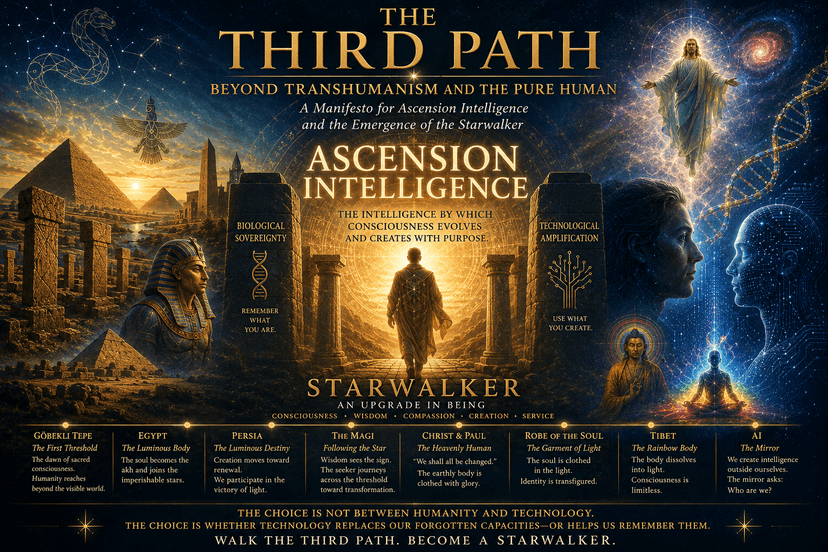
The Third Path
Humanity is being offered a false choice: remain biologically “pure” or merge with our machines. There is a Third Path—one that uses technology without surrendering to it, awakens the latent capacities of the human being, and points toward an ancient possibility: the emergence of the Starwalker.
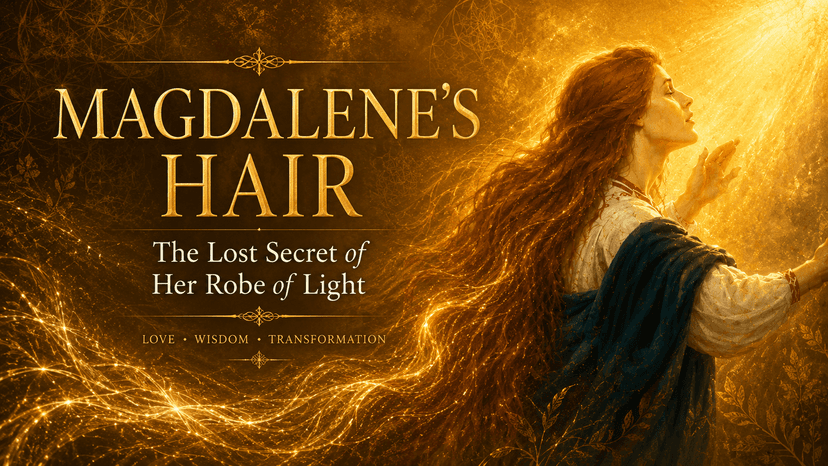
Magdalene's Hair
Why did Christian artists give Mary Magdalene extraordinarily long, red-gold hair? From the mystery woman who anoints Jesus to the Golden Legend’s angelic ascents, her flowing hair evolves into something astonishing: a luminous robe enveloping her entire body. William Henry follows this forgotten thread through sacred hair, celestial nourishment, Samson, the Gospel of Mary and the ancient mystery of the Robe of Light.