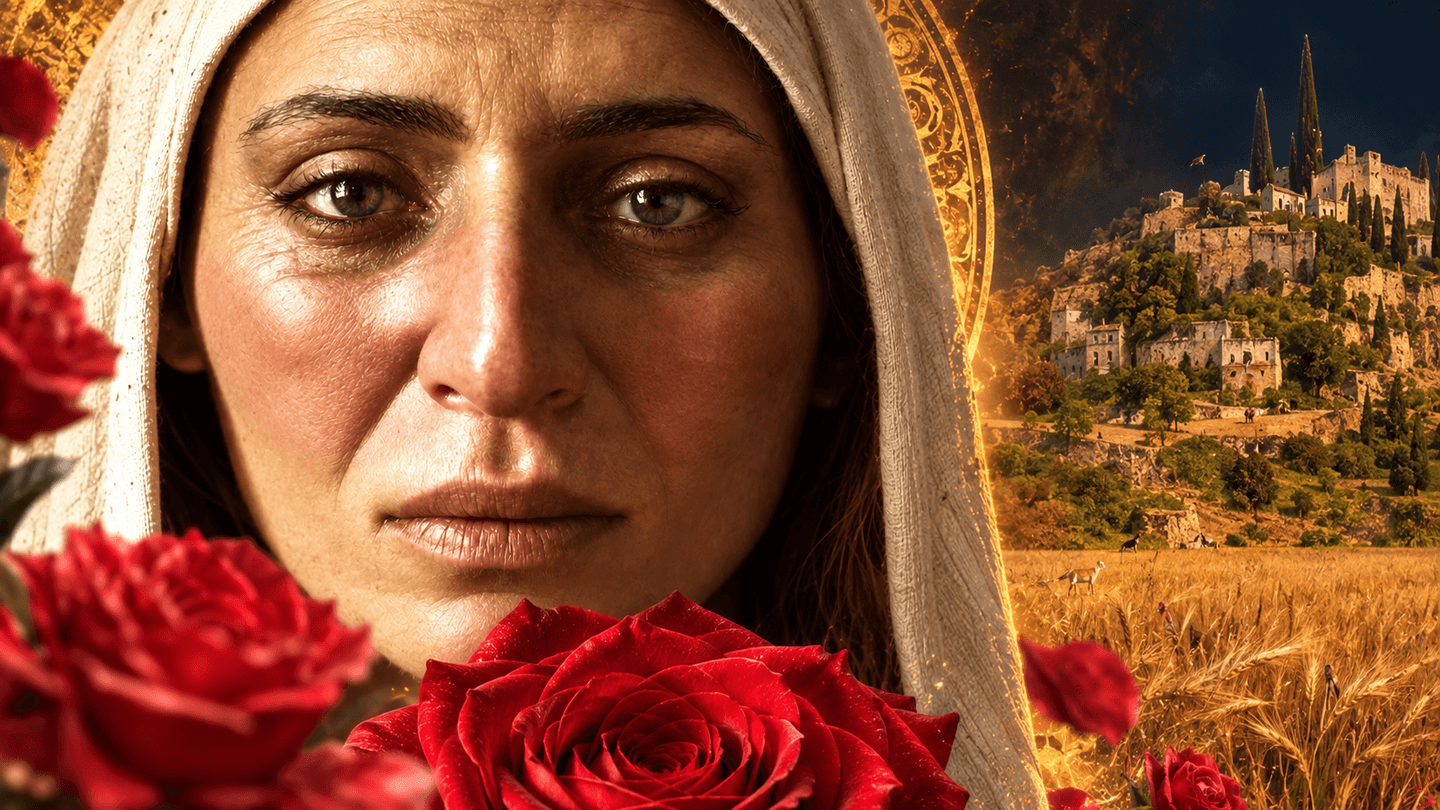
Mary Magdalene and the Secret of the Rose
How the Woman of the Vessel Became the Woman of the Rose
Before Mary Magdalene became the woman of the rose, she was the woman of the vessel.
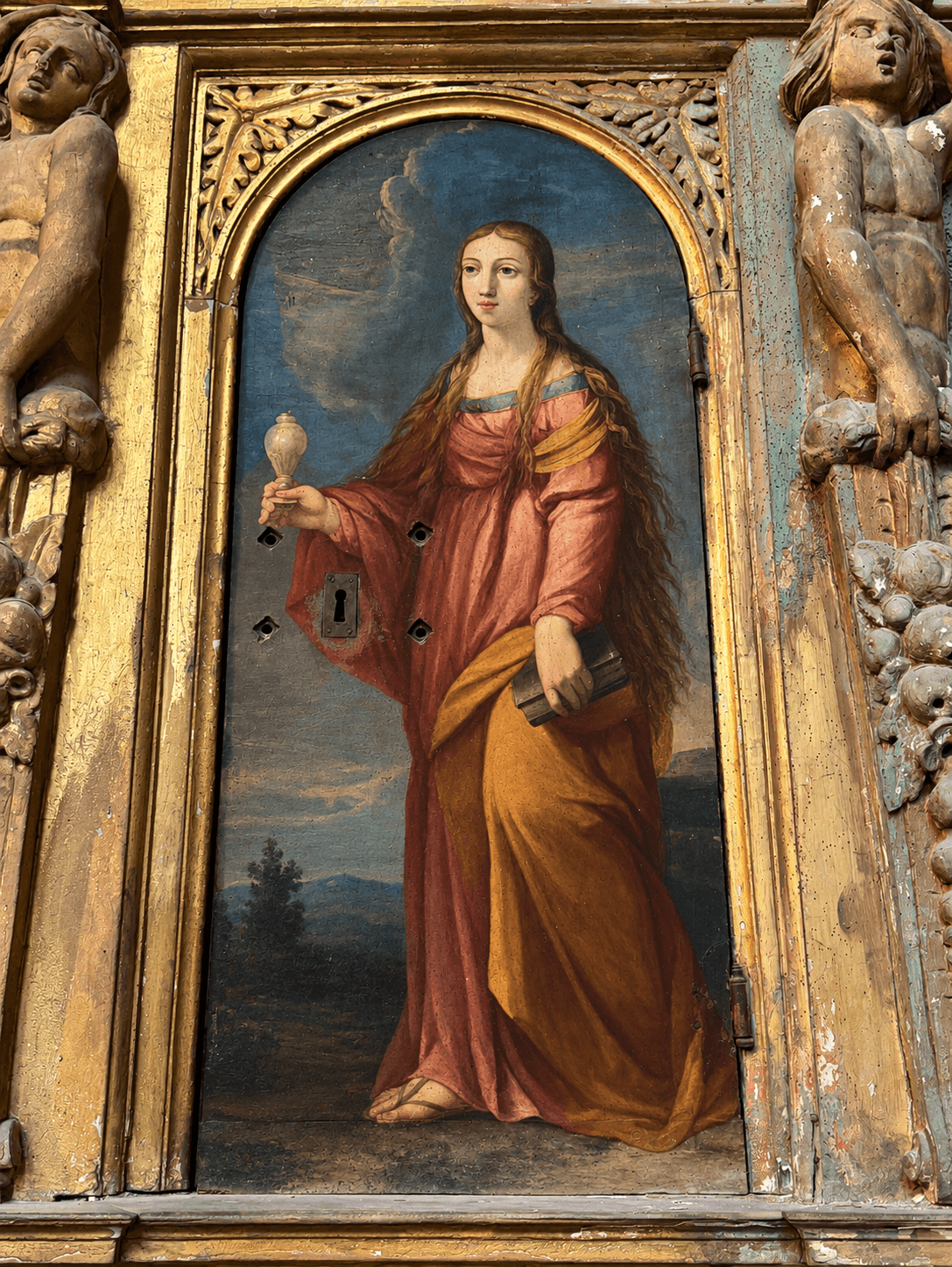
In Christian art she is almost instantly recognizable. A woman with flowing hair. A vessel of precious ointment in her hand. The witness at the tomb. The apostle who announces the Resurrection.
But follow her story westward—through medieval legend, Provence, the troubadours and the flowering symbolism of the sacred feminine—and another image begins to appear.
The rose.
How did this happen?
How did the woman carrying the vessel become associated with Christianity’s most mysterious flower? And could the transformation preserve a deeper memory of what Mary Magdalene came to represent in the Western imagination?
THE VESSEL
One symbol appears repeatedly in paintings of Mary Magdalene.
A vessel.
A jar. A cup. An alabaster container. A precious receptacle holding the aromatic substance or elixir with which the Magdalene was forever associated.
Its contents were worthy of a Messiah (in fact, the vessel was one component of his throne) and may even have played a role in Christ’s Resurrection (as well as his Ascension and then Pentecost).
What is this elixir? A beautiful mystery surrounds that question. I am leading a tour of Southern France dedicated to its lore and secrets June 12-22, 2027 and would like to share some thoughts on this subject and invite you to join the exploration. As with my previous tours, the path leads through another symbol: the rose.
THE ROSE
The rose? And Mary Magdalene? I hear your confusion.
In traditional Christian iconography and history, the rose is overwhelmingly the symbol of Mary, the mother of Jesus, not Mary Magdalene. She is frequently styled as the Rosa Mystica (Mystical Rose) or the "rose without thorns," echoing imagery from the biblical Song of Songs. The thornless white rose is the flower of heaven and the symbol of the Virgin Mary.
But Magdalene? The rose?
If you have been on the Magdalene path for the past few decades, as have I, you may have noticed that calling Mary Magdalene “the Rose,” “Magdalena of the Rose,” or using a specifically Magdalene-centered Rose tradition is increasingly common in modern esoteric/spiritual material related to Lady M. The contemporary Rose Lineage movement repeatedly calls her “Magdalena of the Rose” or “Magdalene Rose” and associates her with a “Red Rose Transmission,” “Rose Priestesses,” “Way of the Rose”, “Rose Path,” and a “Sisterhood of the Rose.”
Something extraordinary is happening around this symbolism.
Because the Magdalene–Rose motif appears to be a relatively recent phenomenon—emerging into popular awareness around 1993, by my reckoning, with Margaret Starbird’s "The Woman with the Alabaster Jar", and gaining enormous momentum a decade later through Dan Brown’s novel "The Da Vinci Code" —an important question arises:
Is the rose an ancient or traditional symbol of Mary Magdalene that has simply been forgotten and is now being revived?
Or is it a largely modern devotional symbol—perhaps an evolution of her traditional imagery, a new layer of meaning that has blossomed around the Magdalene in our own time?
More directly, my investigative mythologist's mind asks, is there a concrete reference linking Mary Magdalene with the rose?
Please note, I am not making a judgment here. Nor am I blindly supporting the legitimacy of the Magdalene Rose concept; I’m simply asking where this blossoming of the Magdalene Rose legacy comes from?
If the Magdalene Rose is the flower, where is the stem that it grew from?
My search of the historical art of Provence, Sainte-Baume and Saint-Maximin, where Magdalene taught and lived, turned up nothing in terms of pictures of Magdalene with roses. There are the expected abundant examples of the Mother Mary with roses, but almost nothing with Mary Magdalene.
Nor does any literary reference in Medieval Provençal Magdalene chronicles explicitly call Magdalene “The Rose.” This is strange. Because if Magdalene had been widely known in medieval Provence as “The Rose,” I would expect the phrase to surface repeatedly in the enormous literature surrounding Sainte-Baume and Saint-Maximin.
Yet, today, the idea of Magdalene as the Rose and her trail through Provence being the Rose Path is everywhere in the air of this awe-inspiring region, but there does not seem to be an historical moment when it became this Path. Did this Rose-Magdalene manifest out of thin air? Not likely. So, how come the source of this belief is not easy to find?
Does it matter?
I think it does. If the rose is not an authentic symbol of Mary Magdalene, then why is it accepted as such?
If it is authentic, then where did the Rose Magdalene Path come from and when did it originate?
Is it the esoteric lore that says the rose symbolizes the blossoming soul? The rose also symbolizes the inner journey, spiritual awakening, and the transmutation of earthly experience into divine love. Magdalene’s oils initiated this transmutation. Was there a moment when the esoteric teachings, the oils, and the rose were ‘secretly’ combined and revealed?
This affirms the importance of our question. As we seek the authentic Mary Magdalene, will we find her by following her original teachings, her elixir, or the ‘new’ rose symbolism?
Yes.
All three.
So, let’s pursue the question of when Mary Magdalene became the Lady of the Rose, or the Sister of the Rose, and when her path became the Way of the Rose. Along the way, we will learn about her original teachings and her elixir.
We will begin by tracing the chronology of her appearance in France.
THE WOMAN WITH THE VESSEL COMES TO FRANCE
Everyone on the Magdalene Rose trail knows about her arrival by boat near Marseilles. It is the foundational reason why she is associated with this area. Sometimes, this story is embellished with various passengers and cargo being included. The fact that this event happened is not questioned.
Historically, Magdalene's association with southern France begins with the "Life of Mary Magdalene and Martha" attributed to Rabanus Maurus (c. 780–856). This document is often presented as proof that the Provençal tradition existed in the ninth century. However, that attribution is not accepted as genuine.
The earliest surviving authentic Latin narrative known to place Mary Magdalene in Provence is the eleventh-century "Vita Apostolica". Following the persecution of the early Christians in the Holy Land, it says Mary joined Maximinus, one of the 70 apostles of Jesus, traveled with him to the Mediterranean, boarded a ship and, “with a favorable voyage, arrived at Marseille.” From Marseille they continued to Aix-en-Provence, where they spread “the seeds of the divine word,” preaching, fasting, and praying to convert the inhabitants.
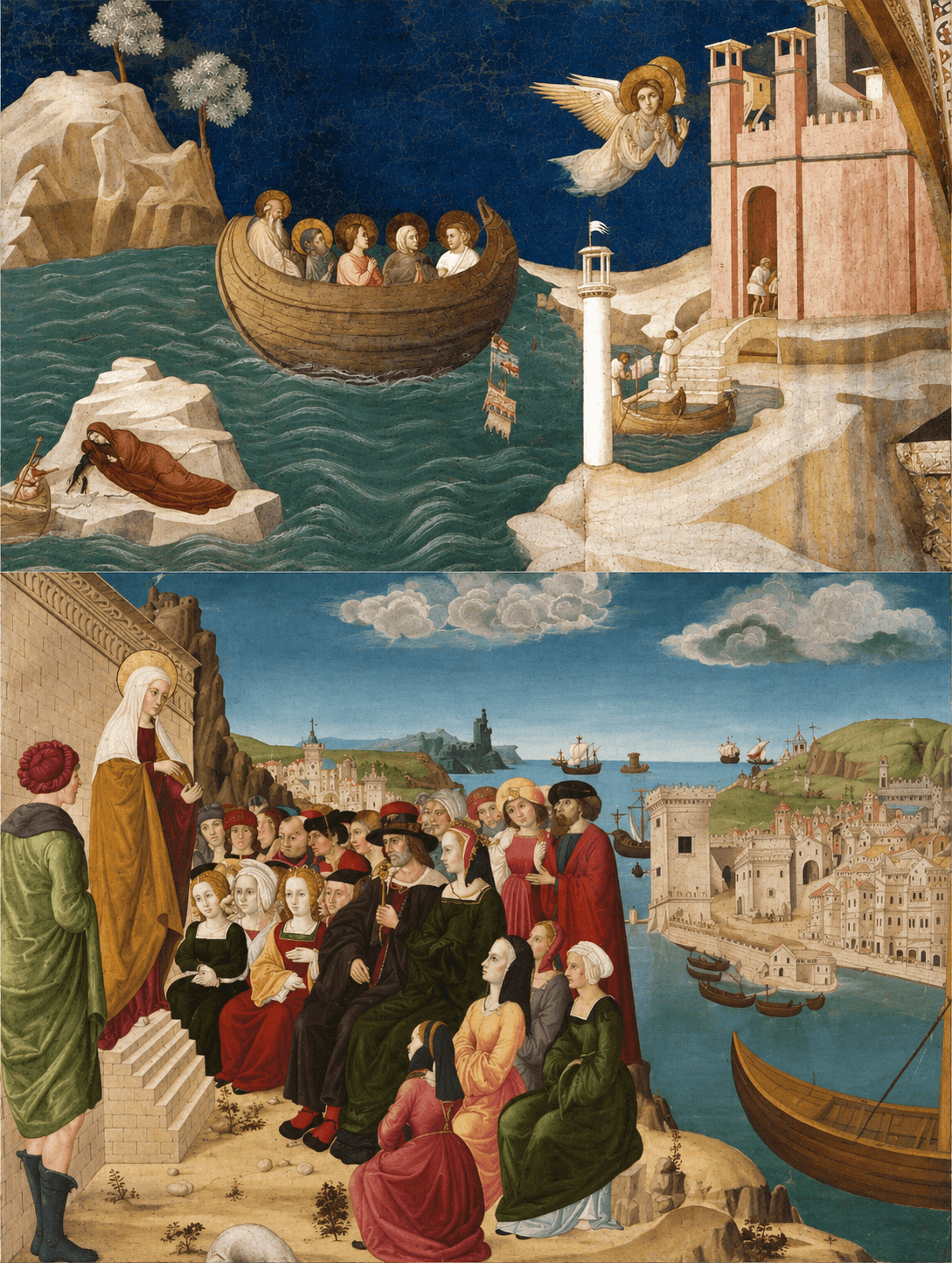
Significantly, the "Vita Apostolica" says it abbreviates an existing account describing how Magdalene “crossed the sea with Saint Maximinus and came into the region of Aix.” This does not prove the tradition dates to antiquity, but it suggests the author inherited an earlier, possibly oral, version of the story.
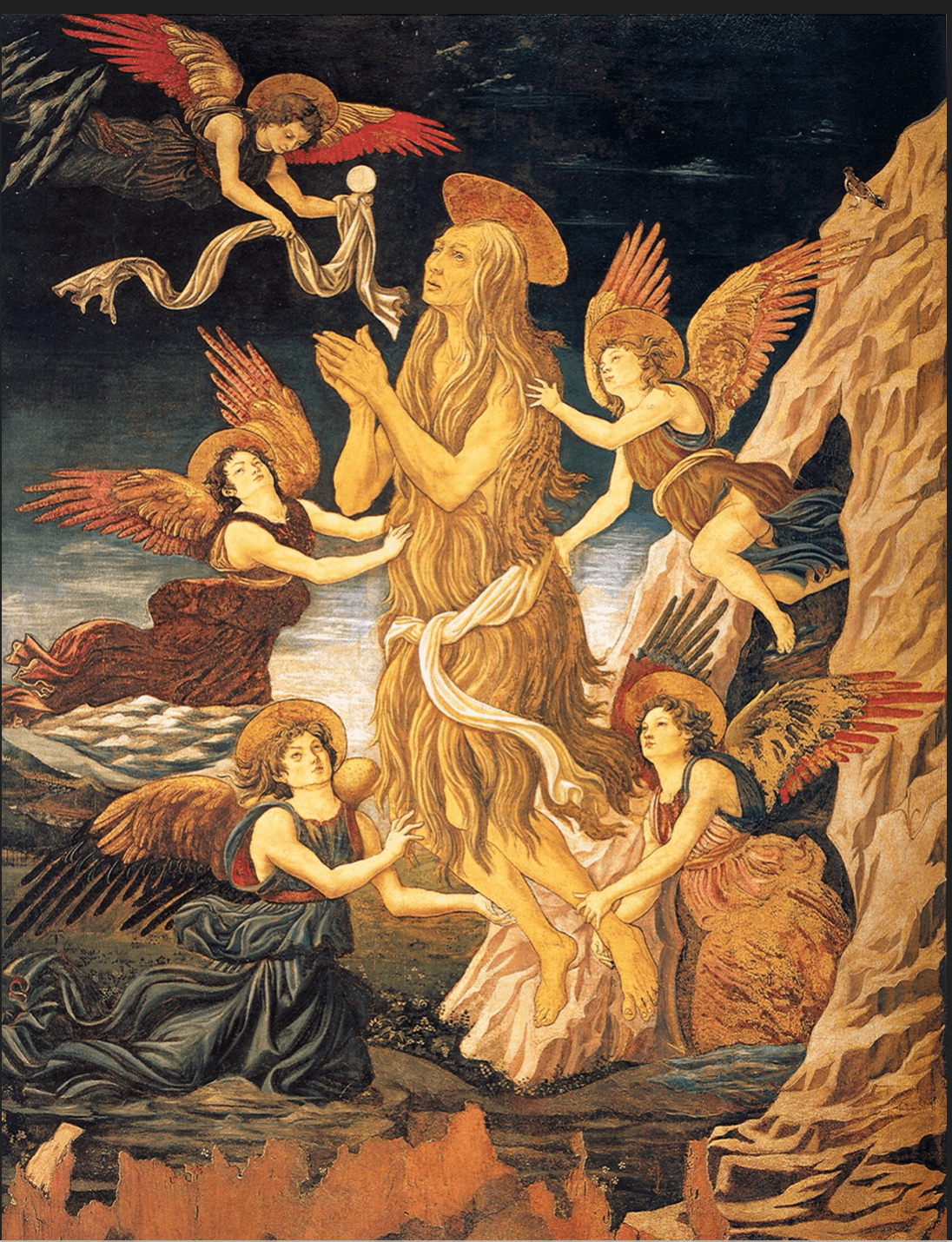
Another text, the "Vita eremitica", told an entirely different story about the end of her life. Maximinus subsequently governs the church of Aix. Magdalene then withdrew into ‘the wilderness’, where she remained in contemplation for thirty years. According to the legend, she lived without ordinary food, sustained instead by heavenly nourishment…angel food or star food. Seven times each day—at the canonical hours—angels raised her “into the ether,” where she heard the celestial harmonies before being returned to earth.
Near the end of her life, angels carried Magdalene to Maximinus. He reportedly saw her suspended two cubits above the ground, surrounded by angels. This inspired many beautiful statues of Mary’s ascension in a vortex of angels. Her prolonged encounters with the heavenly realm had transformed her appearance: her face shone so brilliantly that the text says one could more easily gaze upon the rays of the sun than upon her face. She transfigured, like Jesus, whose face shone like the sun and clothes became white as light (Matthew 17).
After receiving the Eucharist, Magdalene died.
She rose.
A miraculous fragrance reportedly filled the sanctuary for seven days, after which Maximinus anointed her body with aromatic substances and buried her.
The earliest French Magdalene tradition therefore presents a striking sequence: Holy Land origin, sea voyage, landing in Marseille, teaching in Aix, refuge in wilderness, heavenly ascent, celestial food, luminous transformation or transfiguration, fragrant burial, Rising / Ascension.
Notably, the rose does not appear in this early account. Just as the now well-known details about the vessel Mary Magdalene sailed upon having no oars, the passengers being the Marys, plus Sarah, the daughter of Jesus and Mary Magdalene, and the cargo being the Grail were all added later, the association of Mary Magdalene with the rose must therefore be traced through a separate—and apparently later—tradition. One we are seeking to find.
An early-12th-century chronicler, Sigebert of Gembloux, writing around 1105–1111, records that Maximinus brought Magdalene into Gaul and that she was buried near Aix. But Sigebert immediately acknowledges a competing tradition: some writers said Mary Magdalene was buried at Ephesus, where the Mother Mary lived out her years and also rose into heaven.
Also important is that by the 12th century, the cave of La Sainte-Baume was identified as the place where Magdalene spent her final years in sacred contemplation while subsisting on star food.
LADY LOVE
Coincidentally, beginning around 1100, the troubadours of Occitania—Provence, Languedoc, Aquitaine and neighboring regions—began singing about what they called fin’amor, “refined,” “perfected,” or “noble love.”
Around 1230, Guillaume de Lorris began the enormously influential "Roman de la Rose". The first part explicitly inherits the tradition of troubadour fin'amor. And suddenly the central symbol is unmistakable: the Beloved Lady is the Rose.
This was not simply romance.
The lover placed himself in a position resembling a knight before his lord. The Lady was elevated above him. He served her, obeyed her, suffered separation from her, and sought to become worthy of her favor. Troubadour love poetry frequently describes love as something that refines and transforms the lover.
In "Roman de la Rose", the Lover enters a walled garden (just as Mary Magdalene encounters Jesus in a garden on Easter morning), encounters the Fountain of Love (Christ is the Fountain of Living Waters), he sees the roses (the flower of heaven). One particular rosebud (risen, heavenly being?) overwhelms him. Love's arrows pierce him. His quest becomes attaining the Rose.
The Bibliothèque nationale de France describes the basic allegory very directly: the poem recounts the pursuit and gathering of a rose—a young woman—by a young man.
Scholars place the work explicitly within the literary tradition of the Roman de la Rose.
Something incredible is happening.
At exactly the same historical moment that the Magdalene (Sacred Woman, Lover of Christ)-Provence-Ascension-Star Food-Transformation into Light tradition is developing in Provence, the troubadours 200 miles away in Toulouse are singing about the Exalted Lady, devoted lover, spiritual refinement…and the rose.
That doesn't prove that troubadours secretly meant Mary Magdalene the Rose when they spoke about the beloved Lady. But it does establish the cultural bridge by which such an association could later become conceivable.
Moreover, the troubadours created something fundamental: a language in which the Lady could become the transformative object of love. During the next century, the "Roman de la Rose" transformed the beloved Lady into the Rose itself. Meanwhile, in the same medieval French world, Mary Magdalene was emerging as one of Christianity's supreme female embodiments of love, devotion and spiritual transformation. When do those two streams actually meet?
THE KING VISITS
By 1254 (ten years after the last stand of the Cathars at Montsegur) the Magdalene tradition is unquestionably established when King Louis IX visited Provence and went to the cave where Magdalene was believed to have lived as a hermit. According to legend, the cave was prepared for her by angels.
By the end of the thirteenth century, pilgrims traveled into the mountains to the cave where tradition claimed she lived in contemplation and rose to the heavens each day. That’s nearly 750 years of steps modern pilgrims now follow.
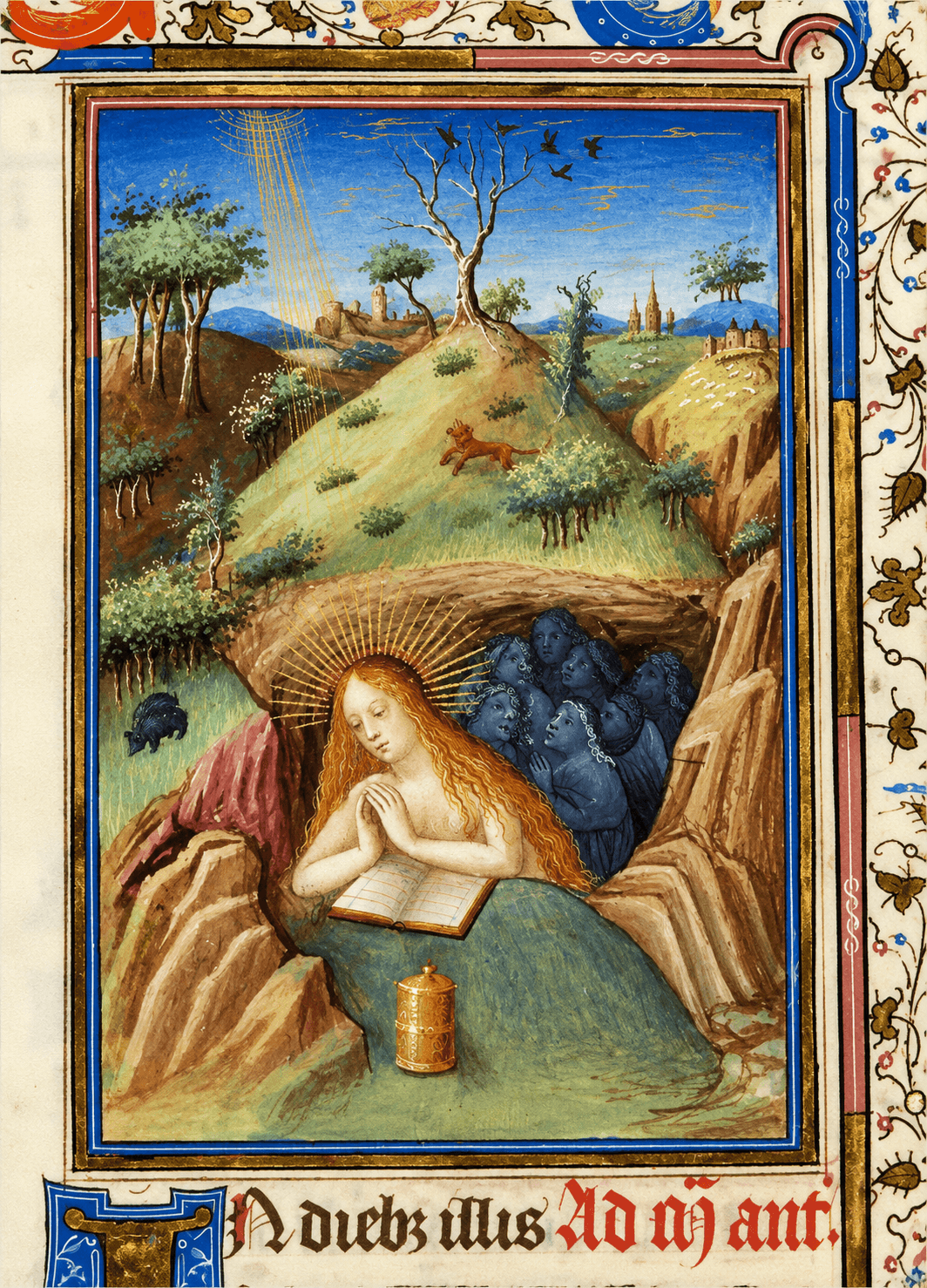
The present Dominican sanctuary explicitly compares Magdalene in the cave to the woman of the Song of Songs:
the beloved hidden in the cleft of the rock.
She is transforming into the lady of the rose while hidden in the cave.
The great turning point came in 1279.
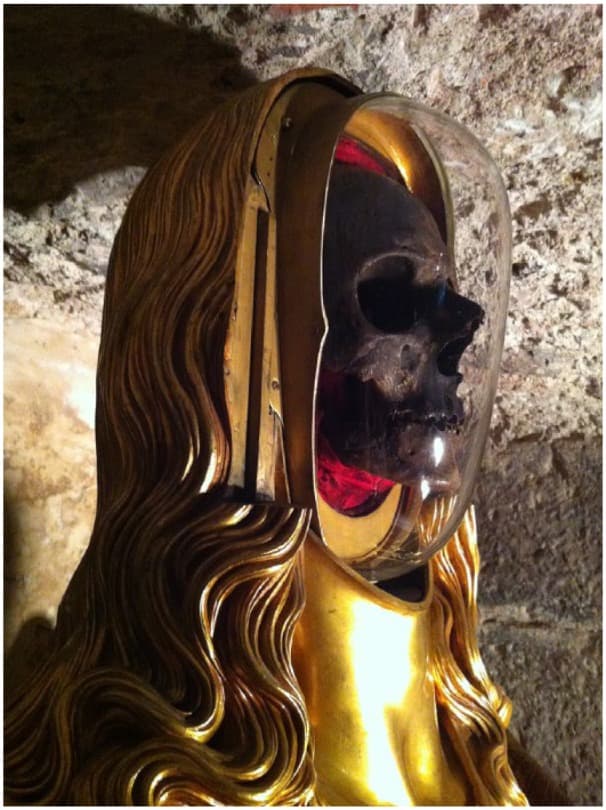
Charles of Salerno ordered an investigation of ancient sarcophagi at Saint-Maximin. Medieval tradition says they discovered remains identified as those of Mary Magdalene there.
The medieval Provençal story says that after Mary Magdalene died, they buried her at Saint-Maximin in an alabaster sepulcher. Centuries later, according to a document said to have been found with the relics, Christians feared that raids would lead to the destruction or theft of her remains. In 710, they supposedly removed Magdalene from her conspicuous alabaster tomb and secretly placed her remains in another sarcophagus—the marble tomb associated with Saint Sidonius.
The purported 710 notice essentially says that her body had been transferred from her “sepulcher of alabaster” into one of marble.
The crucial historical caveat is that scholars do not treat this document as straightforward seventh/eighth-century evidence. The surviving story belongs to the medieval campaign to identify the Saint-Maximin relics, and the authenticity and chronology of the identifying documents have long been debated.
On December 9, 1279, the remains identified as Magdalene's were discovered, not in the supposed alabaster tomb but in the marble sarcophagus.
And according to medieval accounts, when that tomb was opened:
an extraordinary fragrance came out.
Bernard Gui's account compares it to opening a shop filled with aromatic spices. Scholarly examination of the Saint-Maximin relic tradition likewise records the perfume as one of the miraculous signs used to authenticate the discovery.
Tracking this development, when the second vessel is opened, fragrance emerges.
Now Magdalene’s own tomb emitted perfume.
The woman who carried the fragrance in a vessel had become fragrant herself.
The vessel had become the vessel.
Why did medieval Provençals insist upon remembering Magdalene’s tomb as alabaster?
Because the choice of alabaster for tomb one recreates the Gospel image of the woman carrying the alabaster vessel or alabastron.
Mark describes:
“an alabaster jar of very costly ointment of nard.” (Mark 14:3)
Matthew similarly has an alabaster vessel of precious ointment (Matthew 26:7).
In the medieval Western tradition, the anonymous anointing woman, Mary of Bethany, and Mary Magdalene had become conflated by Pope Gregory I into the composite figure of Mary Magdalene.
So the medieval imagination creates a remarkable symmetry:
At the beginning of Magdalene's sacred story: she carries an alabaster vessel containing perfume.
At the end of Magdalene's earthly story: she herself is supposedly placed inside an alabaster vessel.
Her tomb is opened. Fragrance is released.
Thus, in Provence, Magdalene's tomb itself becomes an alabastron. It contains the secret of Mary Magdalene.
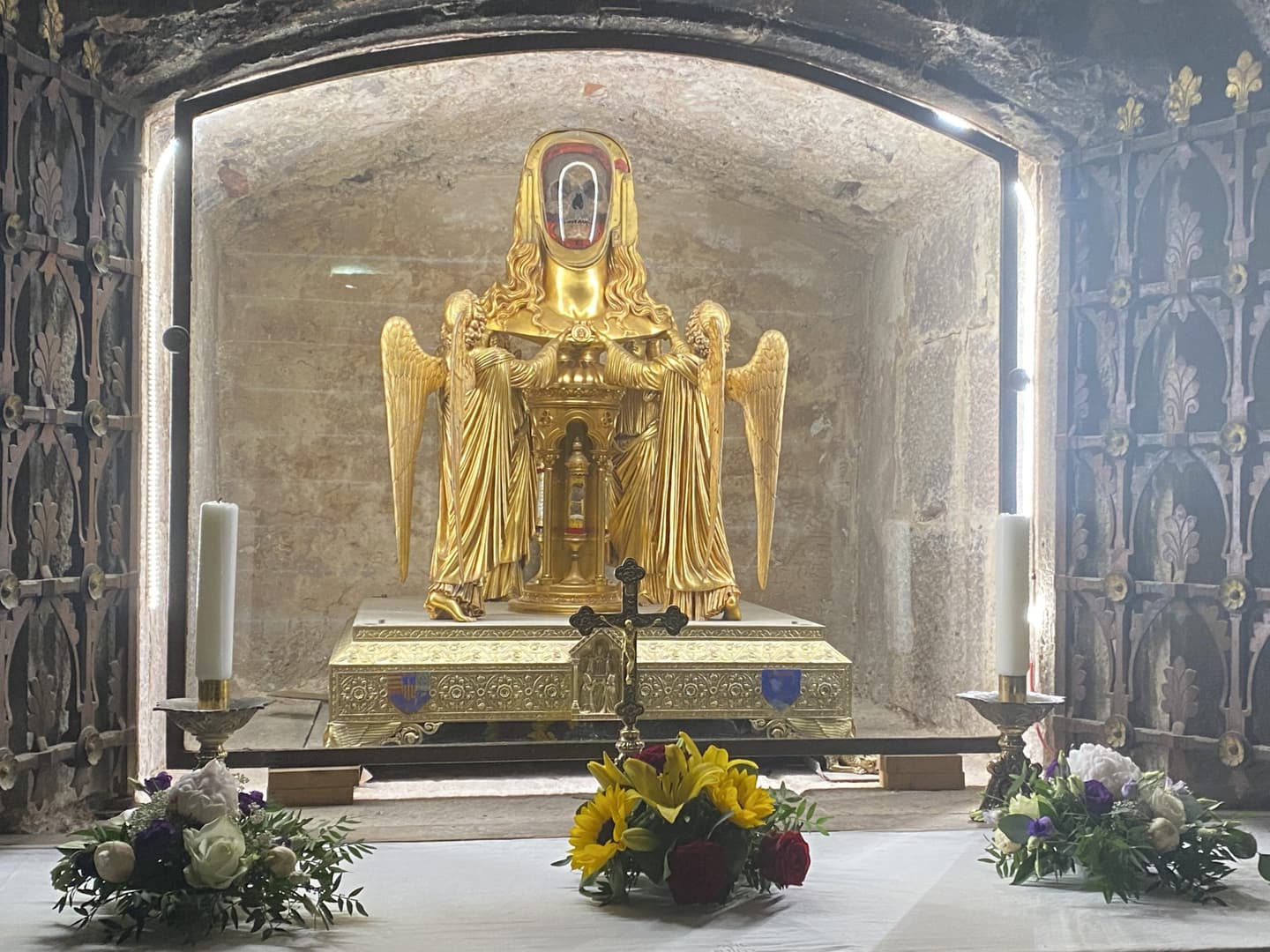
The missing lid is the key to the mystery
The sarcophagus was once surmounted by a carved lid.
That lid has been severely damaged or lost, largely because pilgrims chipped pieces from the tomb as relics.
We actually have a remarkable eyewitness example. In 1474, German pilgrim Hans von Waltheim reported that the prior brought the king's goldsmith with a chisel and had a substantial piece cut from Magdalene's tomb for him to carry home.
Imagine that happening repeatedly over centuries.
Eventually much of the sculptural evidence disappeared.
Later Provençal descriptions claimed that the upper portion had represented episodes from Magdalene's life, including: the anointing at Bethany Magdalene in the house of Simon Magdalene at Jesus' feet Magdalene going to the tomb Magdalene encountering Christ as the gardener Magdalene announcing the Resurrection to the apostles.
In Provençal tradition, the missing carvings portrayed Magdalene's life and helped identify the tomb as hers.
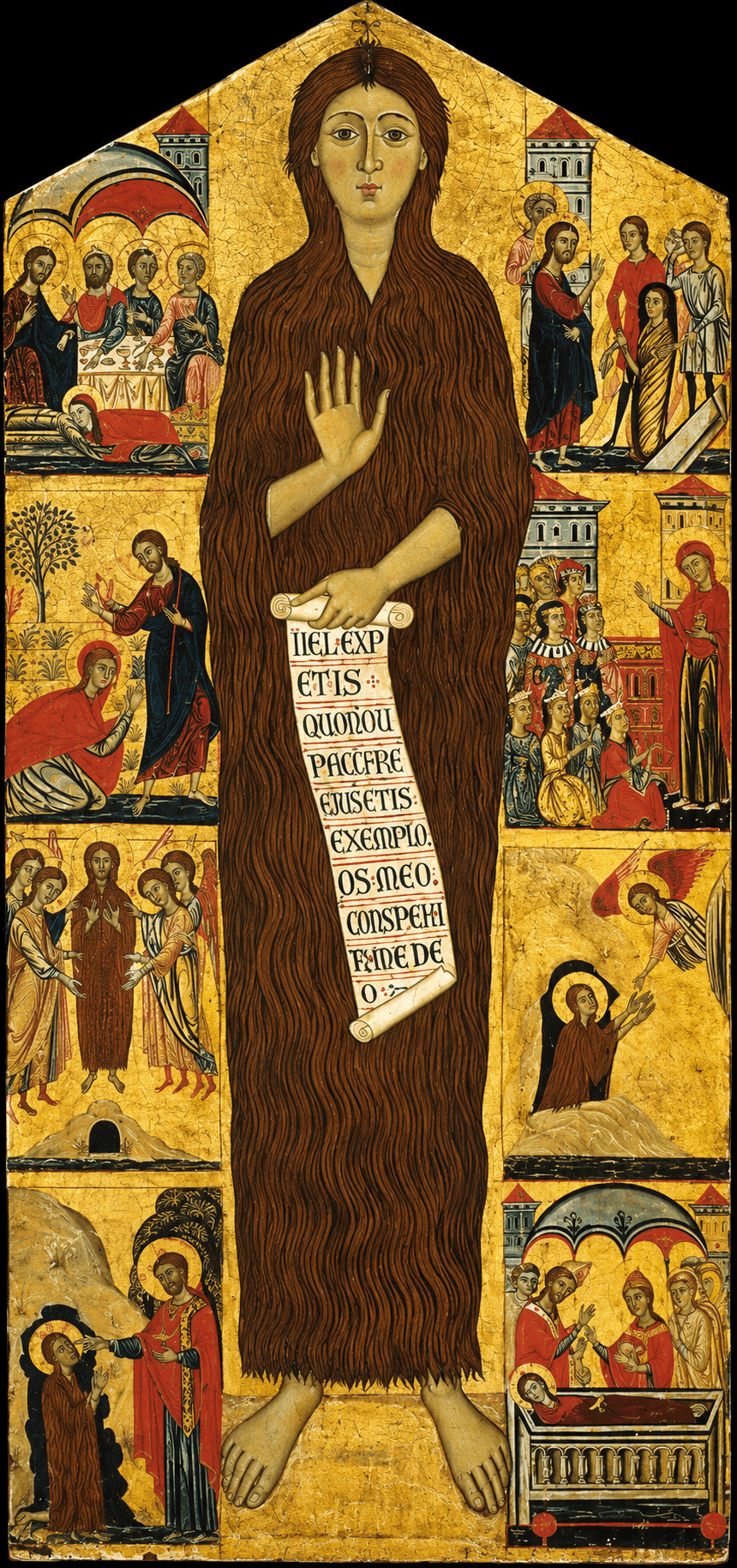
Before moving on, it is important to note that fragrance wasn't the only miraculous sign reported with the opening of her tomb.
According to the traditional account, investigators found a green shoot associated with Magdalene's remains—described in different accounts as fennel or a small palm-like shoot—apparently emerging from her mouth or tongue. In some medieval miniatures and Books of Hours fennel is passed by the lover to his sweetheart. Perhaps someone who loved her very much laid it on her lips?
Interestingly, in Greek mythology, Prometheus used the hollow stalk of a giant fennel plant to steal fire from the gods and bring it to humanity. This gave fennel an association with enlightenment, wisdom, and hidden knowledge. Followers of the Greek god Dionysus carried ritual wands made of fennel stalks.
Later interpretations connected it with Magdalene's status as apostola apostolorum—Apostle of the Apostles: the mouth that proclaimed the Resurrection remained symbolically alive and fruitful.
That gives us: fragrance, plants and the Magdalene.
THE PAINTING THAT CHANGES EVERYTHING
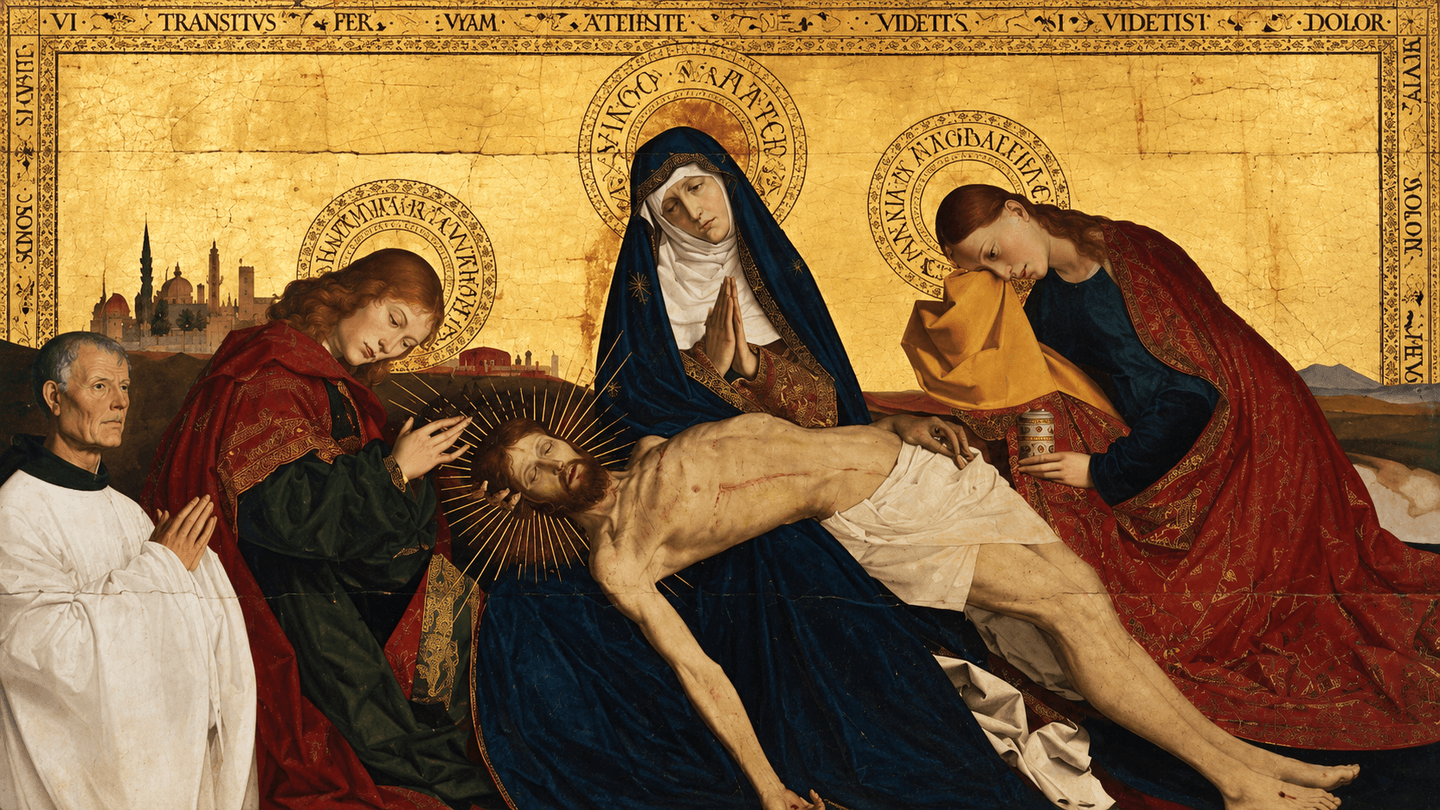
About 175 years after the discovery at Saint-Maximin, we come to one of the most extraordinary Magdalene images produced in medieval Provence: The Pietà of Tarascon.
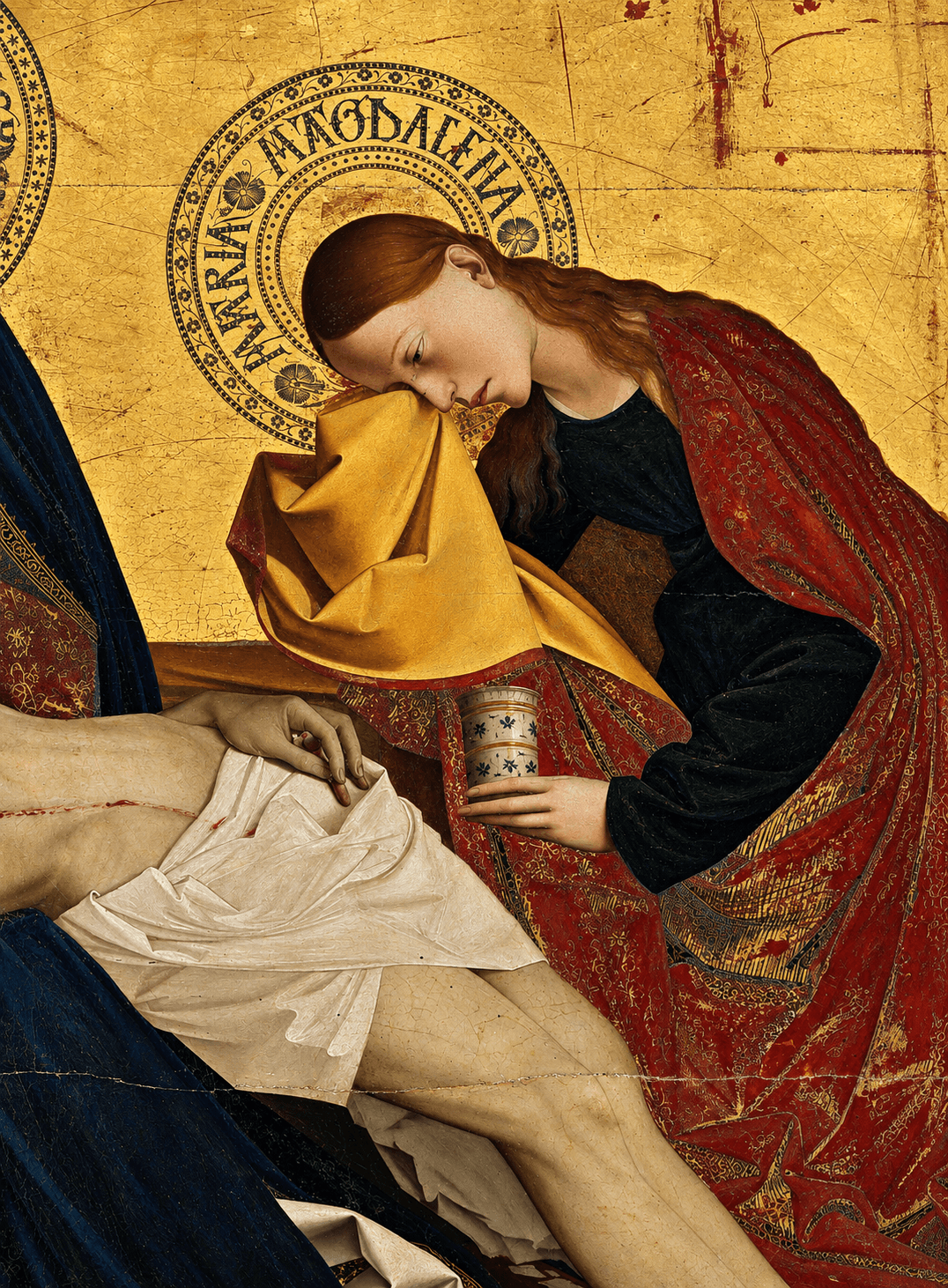
A Provençal artist paints Magdalene at Christ's feet, holding her elaborate golden vessel and applying its contents to his wounds. Her magnificent golden hair cascades over her shoulders.
The work was painted in Provence shortly before 1457 and is now held by the Louvre and deposited at the Musée de Cluny.
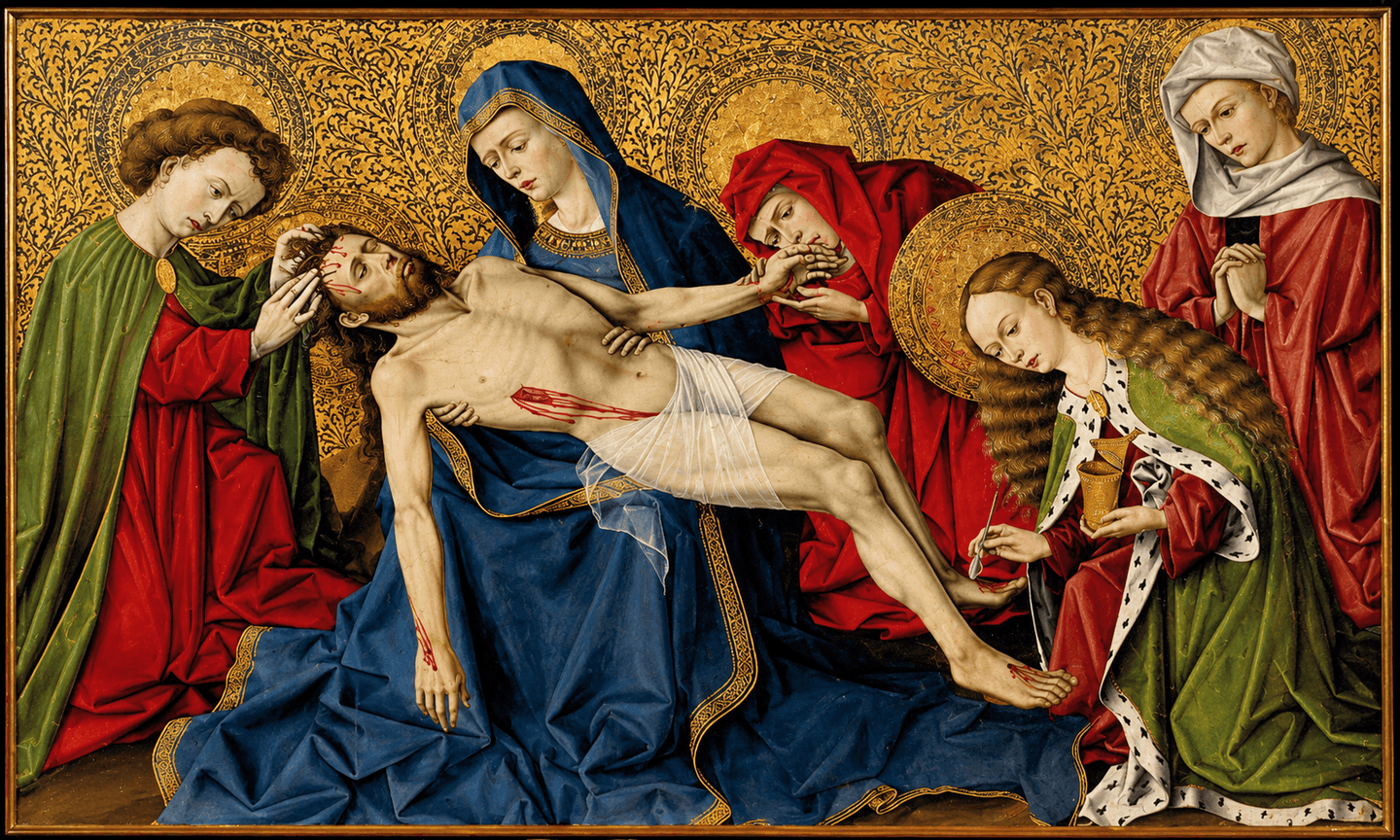
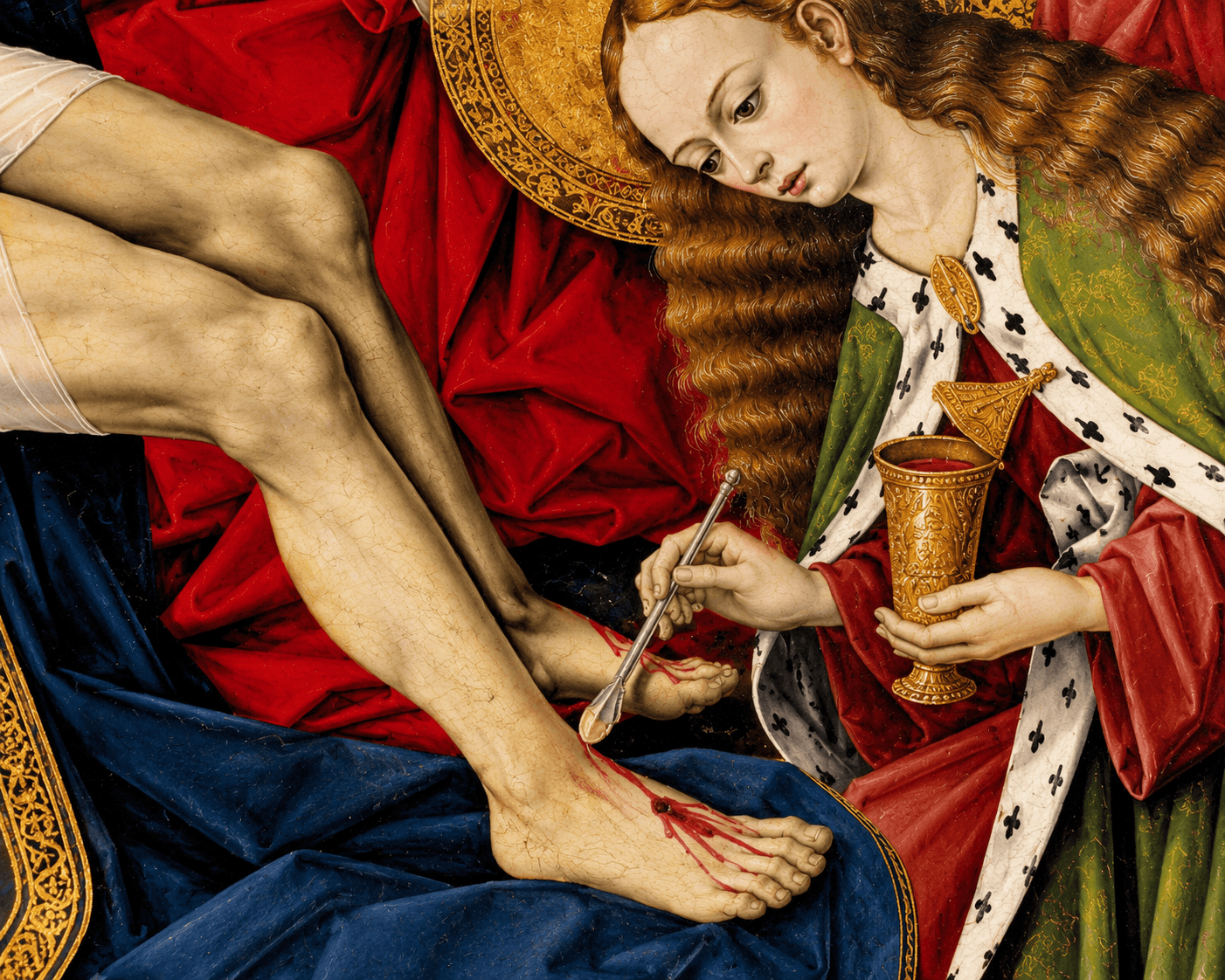
It may once have hung in the private chamber of Jeanne de Laval, the second wife of René d'Anjou, or rather Good King René d’Anjou (1409–1480)— the celebrated king and count of Provence who inherited the Magdalene movement from his ancestors. A 1457 inventory of their Château de Tarascon describes a new altarpiece of Christ in the arms of the Virgin in the queen's chamber. Scholars have connected that record with this painting. A well-known patron of the arts, his court sits at precisely the intersection of Provence, Magdalene devotion, troubadour courtly love, elaborate garden symbolism, heraldry, and late-medieval esoteric imagery.
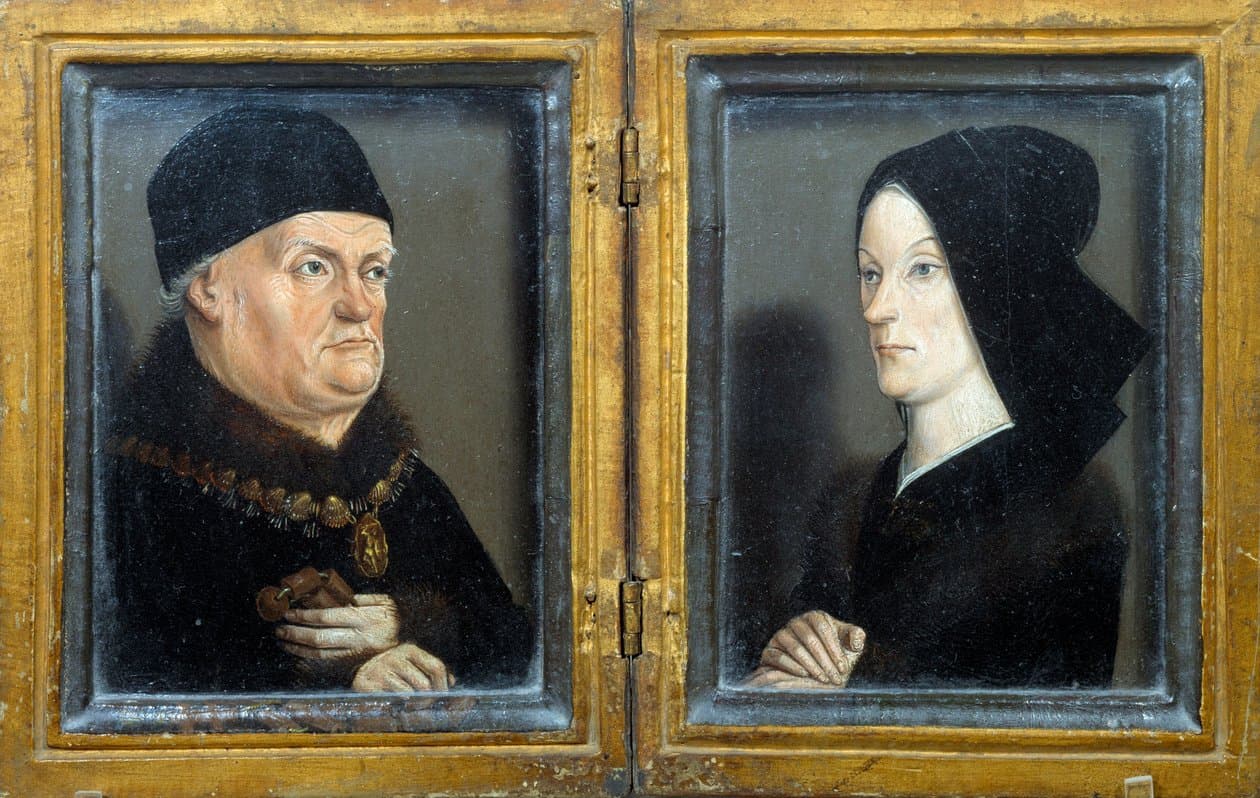
René belonged to the House of Anjou, rulers of Provence whose predecessors had made the search for Magdalene relics at Saint-Maximin almost a dynastic religious project. René inherited that relationship and intensified it. He personally wrote Le Livre du Cœur d'Amour épris (The Book of the Heart Seized by Love), an elaborate allegorical romance in which the personified Heart undertakes a quest for the beloved.
He treated Magdalene not like a remote biblical saint but almost like a protective patron of his house and territory. He sought something of hers that he was certain he would find at Saint-Maximin.
A local historical dossier records René making a pilgrimage in 1438, soon after his release from Burgundian captivity. He first went to Saint-Maximin, descended into the crypt to venerate Magdalene's head, then continued to Sainte-Baume, where he reportedly spent nine days in devotion for himself and his ancestors.
In 1451, René founded a Franciscan convent outside Angers called La Baumette, dedicated to Saint Mary Magdalene. It imitated his beloved Saint-Baume. The authoritative IRHT record states explicitly that its name commemorated the Sainte-Baume in Provence—and, remarkably, that René brought there hair believed to be Mary Magdalene's from Sainte-Baume.
Imagine holding a strand, or even a braid, of Magdalene’s hair.
This takes René's relationship with Magdalene far beyond ordinary royal patronage. He clearly had an exceptionally personal devotion to Mary Magdalene.
Did René d'Anjou believe he descended from her, as modern sources claim? There is presently bloodline claimants descending from Jesus and Mary Magdalene, but no evidence yet discovered shows that René himself made such a claim.
What is historically certain is more tangible: René displayed an extraordinary personal and dynastic devotion to Magdalene, her memory, her relics and the sacred geography of Provence.
Centuries later, modern esoteric writers transformed that documented devotion into evidence for a hidden bloodline. The historical record reveals something arguably more intriguing. René appears to have regarded Magdalene as a deeply personal protector of himself, his ancestors, and his domains. We can feel that devotion today when standing in René’s footsteps in the Magdalene portal he created in Provence.
At roughly the same time, in Gerard David’s Lamentation, Magdalene is again at Christ’s feet, anointing them with ointment from a small pot. The National Gallery explicitly identifies what she is doing and explains that the gesture recalls the earlier anointing at Bethany.
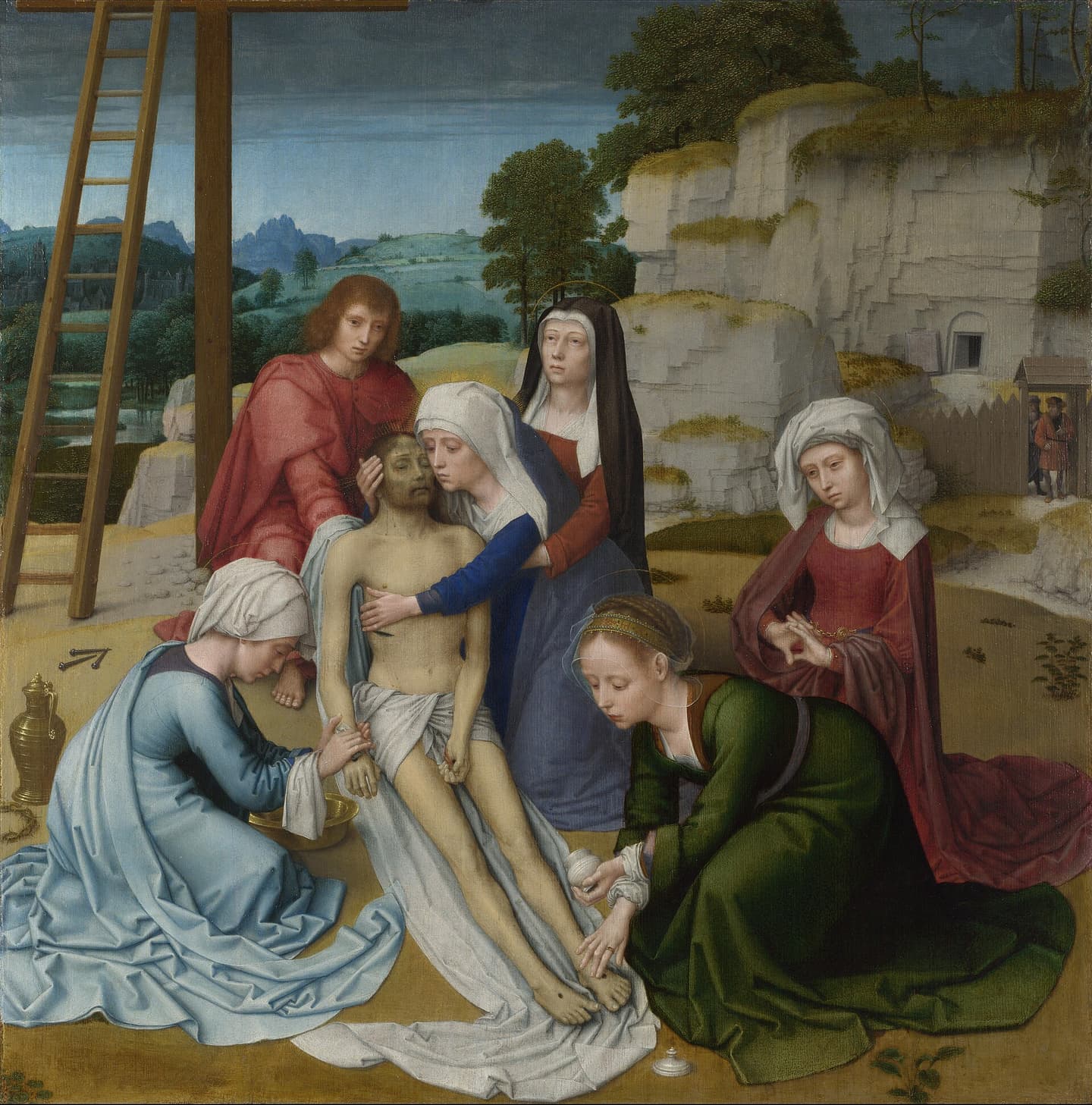
The Gospel act of anointing now becomes a preparation for the Resurrection. The preparation is in the vessel of Mary Magdalene.
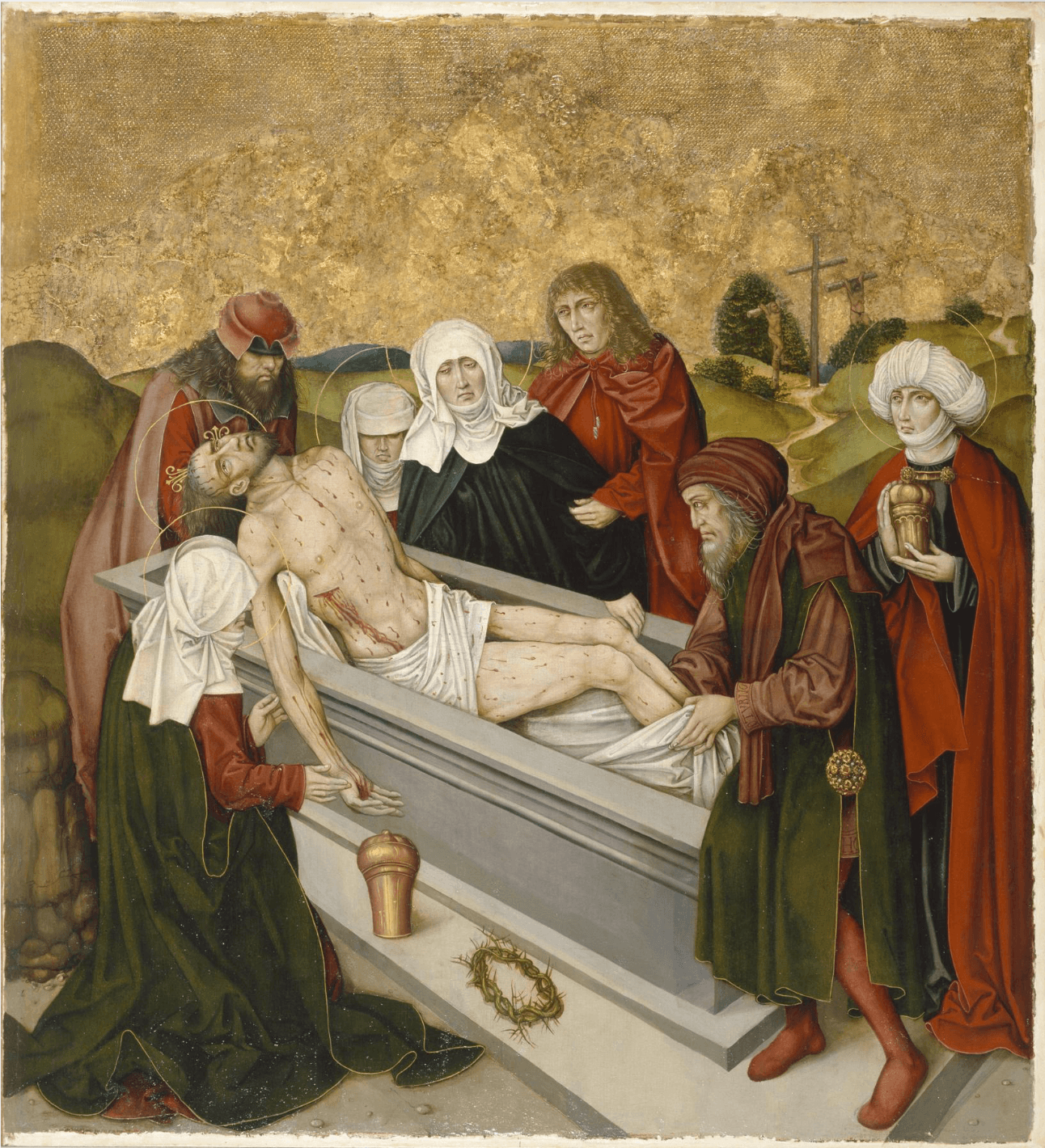
And notice that Nicodemus and Joseph of Arimathea appear in the same painting: the male bearers of burial spices and the female bearer of the sacred ointment converge around Christ’s transformed body.
In Cornelis Engebrechtsz, “The Lamentation with Donors and Saints", c. 1510-15, we see another exceptionally close example. Here again, Magdalene kneels at Christ’s feet and anoints them with ointment. The National Gallery specifically describes her performing the action.
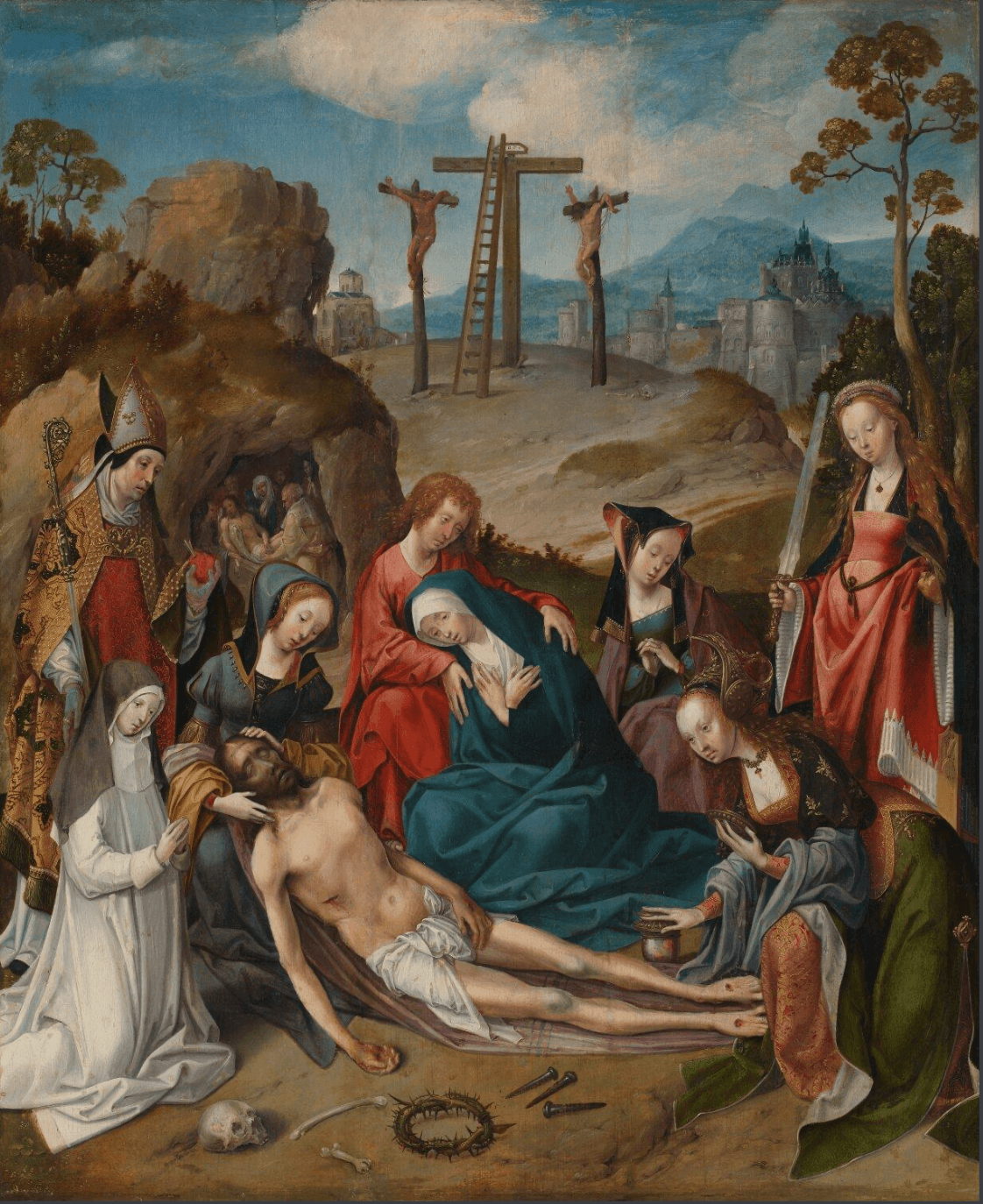
This is important because we’re no longer dealing simply with Magdalene holding her jar as an identifying attribute.
She is actually using its contents upon Christ’s body. These contents will initiate or facilitate his Resurrection
This is the precise iconography of Tarascon.
Another Provençal Deposition, preserved at Pignans near the sacred landscape of Sainte-Baume and attributed to the Avignon school around the end of the fifteenth century, depicts Magdalene holding Christ’s wounded hand while dipping a slender implement into her vessel of ointment, apparently preparing to anoint the nail wound.
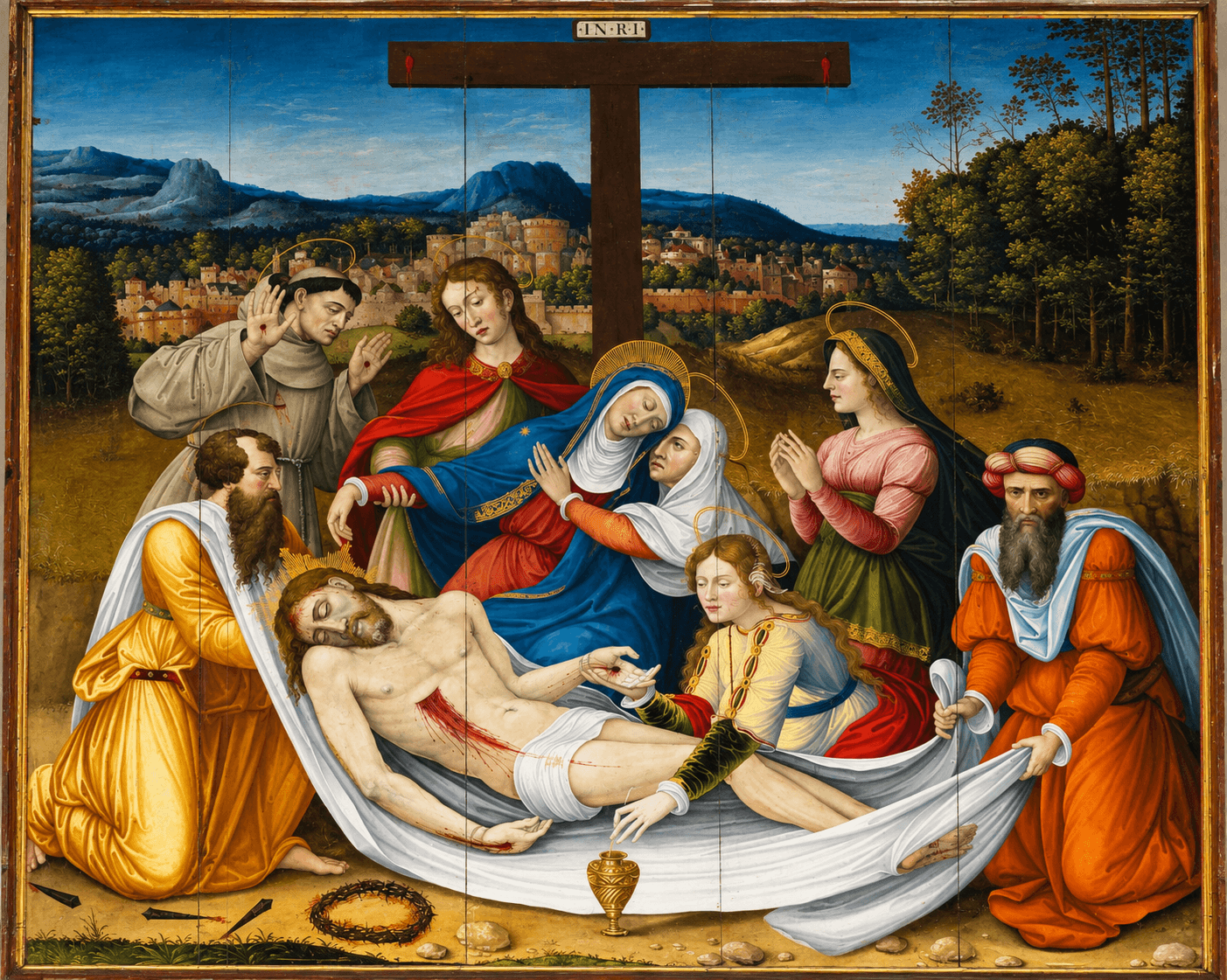
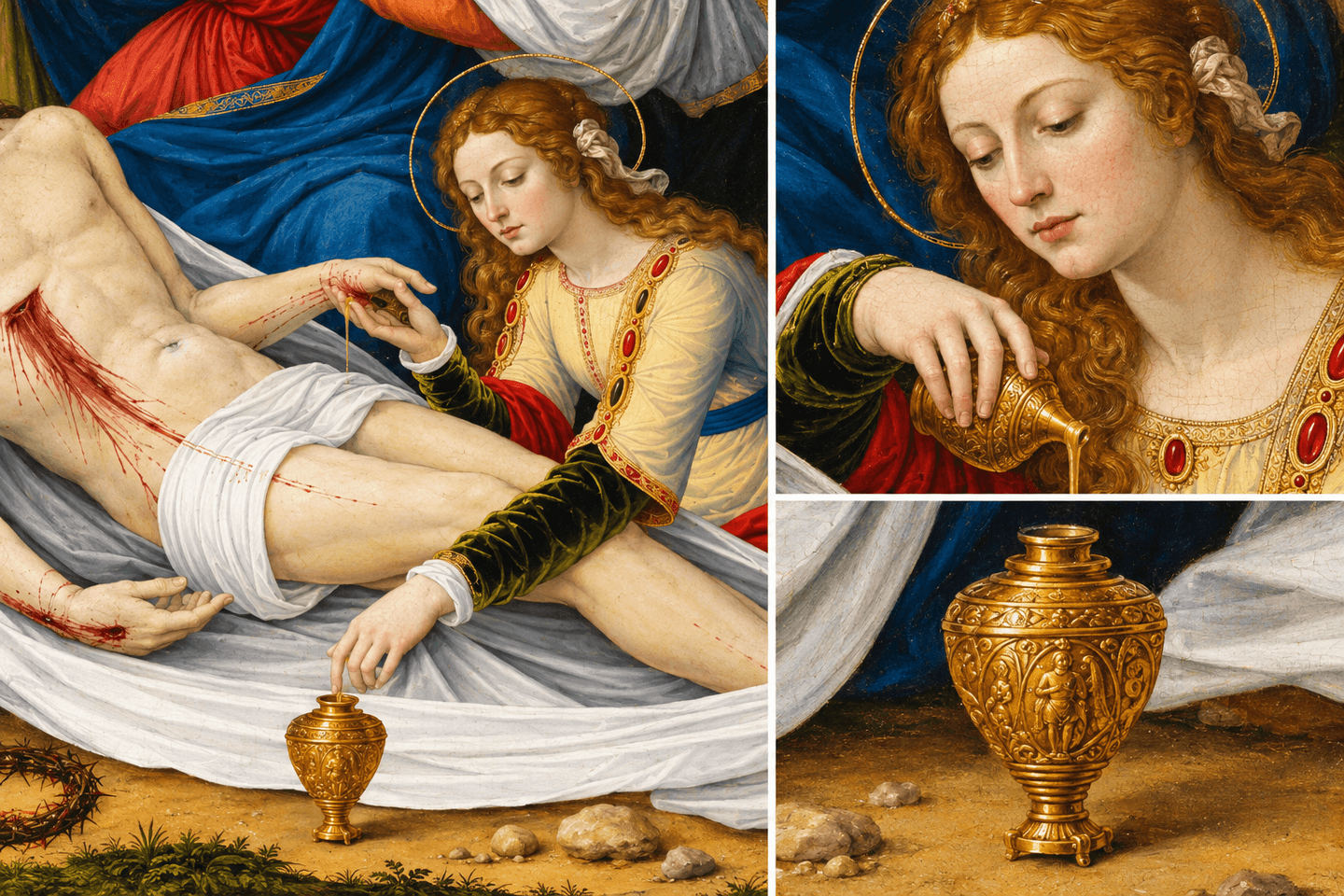
At Tarascon she tends the wound of the foot; at Pignans, the wound of the hand. Together, the paintings suggest a distinct Provencal iconography in which Magdalene’s ancient identity as bearer of the precious ointment extends beyond the Gospel anointing: she becomes the woman who tends the wounds of the bleeding Christ and assists him in his Resurrection.
THE MYROPHORE
This brings us directly into the world of the myrophoroi—the myrrh-bearers.
The Greek myron refers to fragrant oil, perfume or ointment.
The Magdalene therefore belongs to a much older symbolic system:
Vessel. Oil. Myrrh. Fragrance. Anointing. Transformation/ Resurrection.
And this symbolism is not confined to women.
In John's Gospel, Nicodemus arrives at Jesus' burial carrying a remarkable quantity of myrrh and aloes.
Joseph of Arimathea provides the tomb.
Nicodemus brings the aromatic substances.
The women return with spices.
Magdalene comes to the tomb.
Seen this way, the Passion contains what we might call a community of bearers of the sacred fragrance.
Women and men.
Myrophoroi and, symbolically, male myrrh-bearers.
The Sons and Daughters of the Rose.
BUT WHERE IS THE ROSE?
Here our story becomes even more fascinating.
Because in the earliest Provençal evidence I have examined, Mary Magdalene is not primarily the woman of the Rose. That’s the Virgin Mary. She is called rosa caritatis—Rose of Charity—and rosa sine spina —Rose without thorns.
Mary Magdalene is the woman of the Resurrection oils, or perfume, who played an integral role in Christ's Resurrection.
Meanwhile, another extraordinary symbolic development was occurring in medieval France.
The Rose was becoming one of Europe's supreme symbols of love and even, the Holy Grail. he Grail is typically a physical or spiritual vessel (the cup of the Last Supper or the vessel catching Christ's blood). The word chalice comes from Latin calyx, which also means the cup-like outer sepals supporting a flower's petals.
The thirteenth-century "Roman de la Rose" made the rose the center of an immense allegory of desire and mystical love. The Bibliothèque nationale de France describes the work as beginning within the tradition of fin'amor, or courtly love; it became one of the great literary successes of the Middle Ages.
We must tread lightly here.
There is no evidence that "Roman de la Rose" was secretly about Mary Magdalene.
Nor should we interpret every medieval rose as Magdalene symbolism.
The rose belonged to an enormous symbolic universe encompassing the Virgin Mary, courtly love, paradise, beauty, secrecy, erotic desire and divine love.
But in Magdalene’s Provence these symbolic currents existed remarkably close to one another.
And eventually they began to touch.
RENÉ D'ANJOU: THE MISSING BRIDGE?
This is where René d'Anjou becomes particularly illuminating.
And here, inside the world of René's court, we encounter Magdalene not merely as a penitent.
We encounter her as the Anointer.
That image is extraordinary. Even revelatory.
It turns Magdalene's vessel into something almost sacramental.
FROM VESSEL TO ROSE
This suggests a different genealogy for the Magdalene and the Rose.
Not Magdalene = Rose, but Magdalene = the Vessel, Myrrh/Myron, Anointing, Fragrance, Sacred or Mystical Love, the Rose. This extends her genealogy beyond the mystical Jewish tradition into the deep Egyptian and Sumerian myrrophore traditions.
The Rose may therefore be understood not as Magdalene's original emblem, but as a later poetic flowering of qualities already associated with her.
She carries the substance.
She releases the fragrance.
She embodies love.
And eventually that love blossoms.
Just as the soul blossoms in its ascension.
THE SECRET IS FRAGRANCE
This interpretation makes the medieval report from Saint-Maximin even more provocative.
When Magdalene's alleged tomb was opened in 1279, the story did not say that it was filled with roses.
It said there was perfume.
That is precisely what we should expect within Magdalene's medieval symbolic world.
Her identity had become inseparable from fragrance. This symbolism uniquely belongs to the Magdalene. By reporting perfume rather than flowers, the 1279 account from Saint-Maximin-la-Sainte-Baume bypassed generic saintly imagery. Instead, it delivered a highly targeted, sensory validation of her specific identity, confirming to a medieval audience that the "Apostle to the Apostles" was truly present.
The Gospel woman pours out the precious substance.
The medieval Magdalene carries the vessel.
The Provençal Magdalene's tomb releases fragrance; a sweet aroma or relic that was the ultimate proof of holiness, known as the "odor sanctitatis".
And in the Pietà of Tarascon, Magdalene returns to Christ's body with the vessel once again.
With this vessel or container in place, we are closing in on our quest to identify when and how Mary Magdalene became associated with the rose.
WHAT IS THE EARLIEST DATABLE PRIMARY SOURCE THAT EXPLICITLY CONNECTS MARY MAGDALENE WITH THE ROSE?
The earliest securely datable primary source I can presently document that explicitly connects Mary Magdalene herself with the rose is a medieval liturgical Office from Provence associated with the translation of her relics at Saint-Maximin.
The surviving manuscript evidence dates the text to no later than the 14th century, and the Office was probably composed in connection with the Angevin/Dominican promotion of Magdalene's relics after their purported discovery in 1279.
And it doesn't merely mention a rose.
It calls Magdalene a red rose.
“ROSA RUBENS ET NOVELLA”
The Office contains this responsory addressed directly to Magdalene:
Rosa rubens et novella
Literally:
“Red and newly blossoming rose.”
The fuller verse describes her as a red rose and compares her sweetness to honey, associating the image with her virtue and grace.
This is enormously significant because this isn't modern Magdalene spirituality.
It isn't nineteenth-century romanticism.
It isn't twentieth-century esotericism or twenty-first-century channeling or fiction. Neither Margaret Starbird nor Dan Brown mention this source document in their labeling of Mary Magdalene and the Rose.
It is medieval Magdalene liturgy associated with Provence itself.
And there is a second rose reference in the SAME Office
The third antiphon for Matins reads:
Magdalene velut rosa, corpus fragrat seculo.
The recent scholarly translation renders the passage essentially:
“Like a rose, the body of Magdalene perfumes the world.”
This is extraordinary, given the trail we've been following.
The scholarly study by Nils Holger Petersen and colleagues identifies the Office for the 5 May Translation of Mary Magdalene as surviving in two medieval breviaries: a 14th-century breviary from the diocese of Aix, now Archives départementales des Bouches-du-Rhône, 2 G 1859, fols. 306v–308 an Aix breviary copied in 1467, Paris, Bibliothèque nationale de France, Latin 1061, fols. 272–273.
The scholars argue that the Translation Office was probably composed by a Dominican from Saint-Maximin and explicitly connects it with the political and devotional program surrounding Charles II of Anjou and the establishment of Saint-Maximin as the center of Magdalene devotion.
But there is something even more remarkable.
Remember the story we've been uncovering about the opening of Magdalene's tomb? The medieval tradition claimed that when the sarcophagus was opened, an extraordinary sweet fragrance emerged.
Now look again at the liturgy composed to celebrate her relics:
Magdalene velut rosa, corpus fragrat seculo.
Magdalene, like a rose, her body perfumes the world.
That is almost certainly not an accidental juxtaposition. The rose is being used to interpret the fragrance of Magdalene's body. She is the rose. She has become rose fragrance. (Because she applied the contents of the vessel upon herself?) So the conceptual chain becomes:
THE GOSPEL ALABASTER VESSEL contains PRECIOUS PERFUME Magdalene pours it out.
THE PROVENÇAL LEGEND Magdalene is placed in a tomb traditionally remembered as alabaster. Her body becomes the precious substance inside the vessel (in my view, because she has used the contents of the vessel) 1279 The hidden sarcophagus is opened. FRAGRANCE EMERGES.
MEDIEVAL PROVENÇAL LITURGY ROSA RUBENS ET NOVELLA Magdalene is the Red Rose. And: MAGDALENE VELUT ROSA CORPUS FRAGRAT SECULO
Like a rose, Magdalene's body perfumes the world.
We are now clearly in Magdalene’s garden of roses.
And notice the color
The Office doesn't simply call her rosa.
It calls her:
ROSA RUBENS
THE RED ROSE.
That gives us everything we need to associate the Magdalene with the rose. It is no longer an esoteric stretch or fictional device.
It is historical.
It should still give us pause. We shouldn't automatically read later esoteric meanings—bloodline, Rosicrucianism, sacred feminine traditions, etc.—back into a medieval liturgical phrase. In fact, that may obscure the actual meaning of the rose symbolism, i.e. resurrection.
Within medieval Christian poetic vocabulary, red commonly evokes love, charity, ardor, blood, sacrifice and spiritual fire.
But in Magdalene's particular case the combination is striking:
Red Rose- Fragrance- Body Anointing- Love Relics
All appear within the same devotional ecosystem.
This changes the historical conclusion.
Earlier I told you that I couldn't substantiate a medieval Provençal Magdalene–Rose tradition.
We now can
And not merely through a painting where a rose happens to appear beside Magdalene.
We have a liturgical text devoted specifically to Mary Magdalene, apparently produced in the Saint-Maximin/Provençal environment, that addresses her as:
ROSA RUBENS ET NOVELLA
and separately says:
MAGDALENE VELUT ROSA, CORPUS FRAGRAT SECULO.
That is primary-source evidence. This is the moment when the Magdalene Rose blossoms.
The earliest firm evidence is not that Mary Magdalene was originally identified with a rose, but that her Provençal presence developed first, and the rose symbolism seems to have attached to her later.
The symbolism has to do with her rising.

CONCLUSION / NEXT STEPS
What began as an exploration of a simple question — when did Mary Magdalene become associated with the rose —has led us to a remarkable path and a new question. What is the connection between the rose and the contents of Mary Magdalene’s alabaster jar and resurrection, Jesus's and hers? More, is her 'Starbucks name' Rosa Rubens?
I have just returned from Turkey where, legends say, Adam and Eve first emerged after their eviction from Eden. Eve brought wheat with her. Adam brought a pomegranate and a rose bush. After toiling in the fields, he fashioned the rose bush into a plow. An ox appeared and told him to yoke the plow to him. Now, Adam could do more work in less time and began to devote more of his energy to returning through the gate of Eden. In Christianity, Jesus is the way-shower through that gate. Mary Magdalene made an oil out of rose that initiated or facilitated his Resurrection.
Was the rose originally brought from heaven to earth for this purpose?
Join me on the Rose Path of Mary Magdalene in Southern France June 12-22,2027 and find out.
About William Henry

William Henry is a Nashville-based author, investigative mythologist, and TV presenter. He is an internationally recognized authority on human spiritual potential, transformation and ascension.
He has a unique ability to incorporate historical, religious, spiritual, scientific, archaeological and other forms of such knowledge into factually-based theories and conclusions that provide the layperson with a more in-depth understanding of the profound shift we are actually experiencing in our lifetime.